

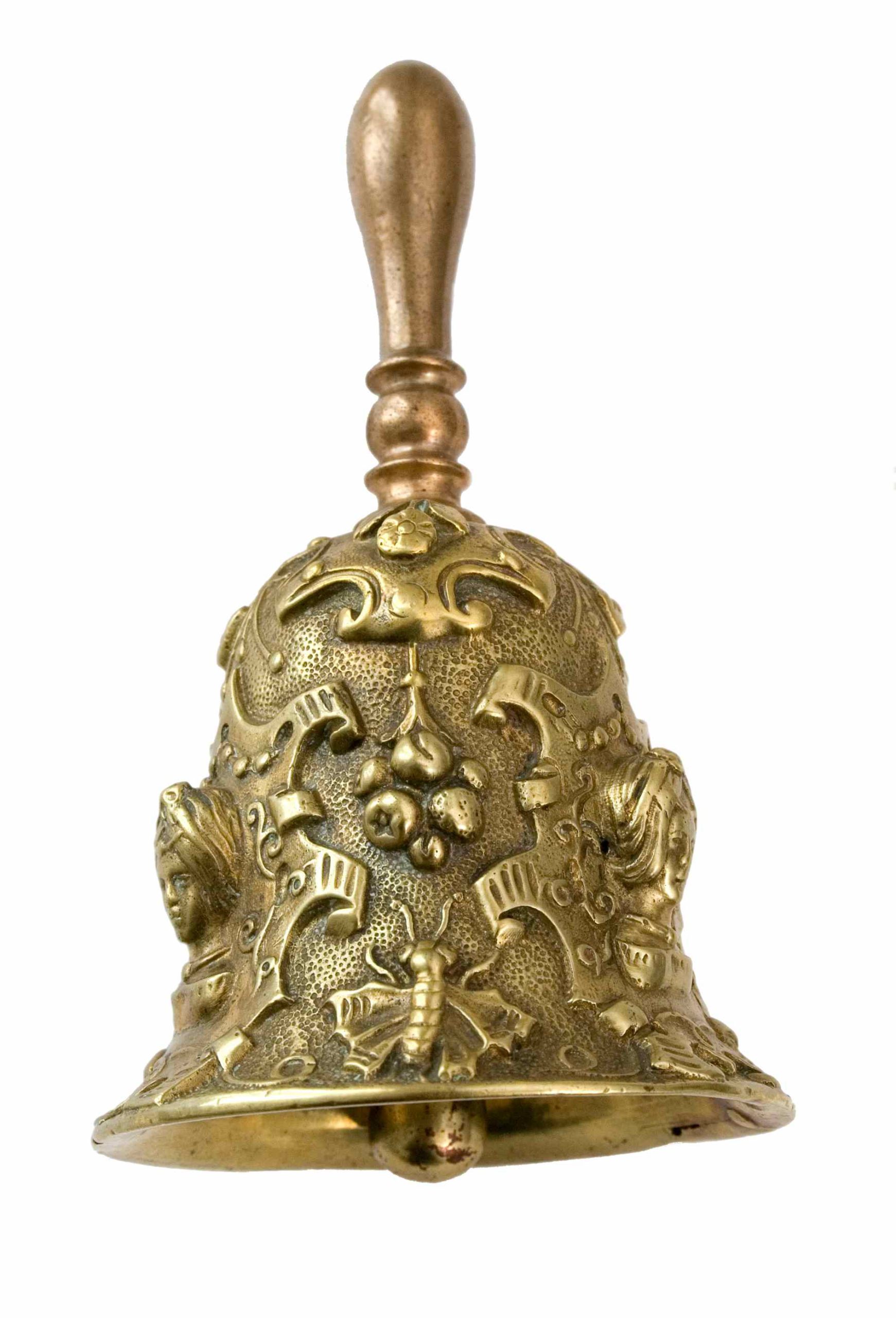
The bell, probably cast in the second half of the 19th century, is made of brass. It has a cup-shaped shape and a smooth handle attached to the cap with a threaded nut. Its entire exterior is covered in convex relief with decoration in Neo-Mannerist-Neo-Baroque motifs, consisting of scrollwork elements, cartouches with a female bust and bunches of fruit, and at the bottom, on a wreath alternating with the lower part of the cartouches, depictions of insects with spread wings. A brass heart in the form of a club hangs inside the cup. The bell is distinguished by its high-quality casting and is an artifact representing the eclecticism fashionable in art at the time.
Bell with rich convex decoration, 2nd half of the 19th century, unknown caster, material and technique: brass, cast, chiseled; dimensions: bottom diameter 6.6 cm, height 12 cm (including handle); cup-shaped, with a club-shaped heart. It belongs to the collection of the National Museum of the Przemyśl Region. This small bell, cast in brass, is golden, covered with a light patina, has a cup-shaped form, and a smooth club-shaped handle. The handle is attached to the inverted cup with an externally invisible nut. The entire outer surface of the bell’s cup is covered with a convex relief decorating the bell’s casing. This decoration consists of small elements, such as cartouche discs with a female bust alternating with bunches of fruit. At the bottom, on the bell’s heart ring, there are also convex depictions of insects with spread wings, depicted alternating with the lower portion of the cartouches. A brass heart in the form of a club hangs inside the chalice. The bell is distinguished by its high-quality casting and is an artifact representing the eclecticism fashionable in art at the time.