

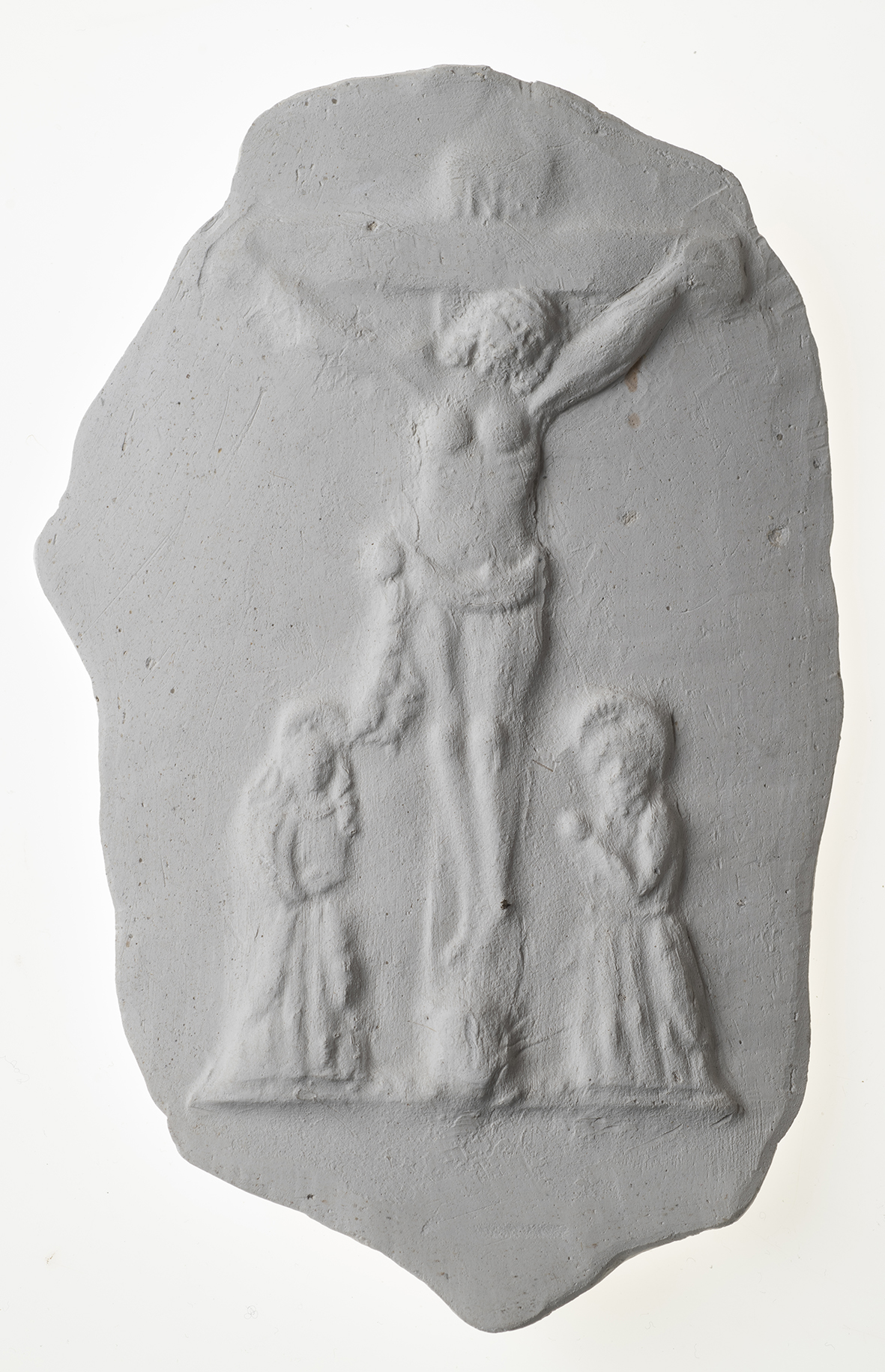
The display case presents part of a collection of plaster casts from the decorations of now-defunct bells. These were confiscated during World War I as material for the Austro-Hungarian Empire’s armaments industry. Confiscation of metal products took place throughout Galicia. The Austrian government established criteria for bells, intended to demonstrate goodwill towards preserving the oldest and most valuable bells, both historically and artistically. Unfortunately, in many cases, these criteria were not respected. Polish conservators, as well as specialists in art and history, were asked to assist in classifying the bells slated for confiscation. In the Przemyśl region, Dr. Mieczysław Orłowicz, author of guidebooks to Galicia, and Kazimierz Osiński, architect and engineer, founder of the Museum of the Society of Friends of Science in Przemyśl, were given this “chance to save” the bells. Thanks to their efforts, in 1917, approximately four hundred bells were preserved, and those that could not be saved were thoroughly documented, and plaster casts of the designs were made. The collections of the National Museum of the Przemyśl Region include 65 plaques with casts of ornaments, inscriptions, and figurative representations. These were acquired by Osiński in the museum’s first collections. The plaques are an invaluable trace and source of information about lost heritage. Among those presented in the exhibition, a plaque with the scene “Crucifixion” deserves special attention, cast from a confiscated bell from Dylągowa. Based on the style of this bas-relief, it was possible to identify Michael Wittwerck’s bell foundry in Gdańsk, where the bell was cast in 1743. Other plaques attest to the high artistic standard of bell decoration.
Unknown artist, plaque “Crucifixion,” 1917, Poland under the Austro-Hungarian partition. Cast, plaster. Dimensions: height 19.5 cm, width 12 cm, depth 1.2 cm. Collections of the National Museum of the Przemyśl Region in Przemyśl. The plaque is a cast of bell decoration. It has an elongated shape with irregular edges. In the center is a convex relief with the scene “Crucifixion.” The plaque’s background is smooth, resembling the surface of the bell. On the cross is the figure of a naked Christ, his hips girded with a narrow cloth called a perizonium. At the bottom of the cross, on either side are two figures. On the left is Mary, the mother of Jesus, and on the right, probably St. John. Their heads are surrounded by a halo – a symbol of holiness. The figures are dressed in long robes arranged in vertical folds. The relief was imprecisely cast, which can be felt in its blurred contours. The plaque presented is a plaster cast of the decoration of the now-vanished bell from Dylądowa. It was created in 1743-1745 in Michael Wittwerk’s bell foundry in Gdańsk. This bell, like hundreds of others, was melted down to produce weapons for the Austro-Hungarian army during World War I. The museum’s collection includes 65 similar casts of ornaments, inscriptions, and figurative representations, made from bells before their destruction. Some of these are featured in this exhibition.