

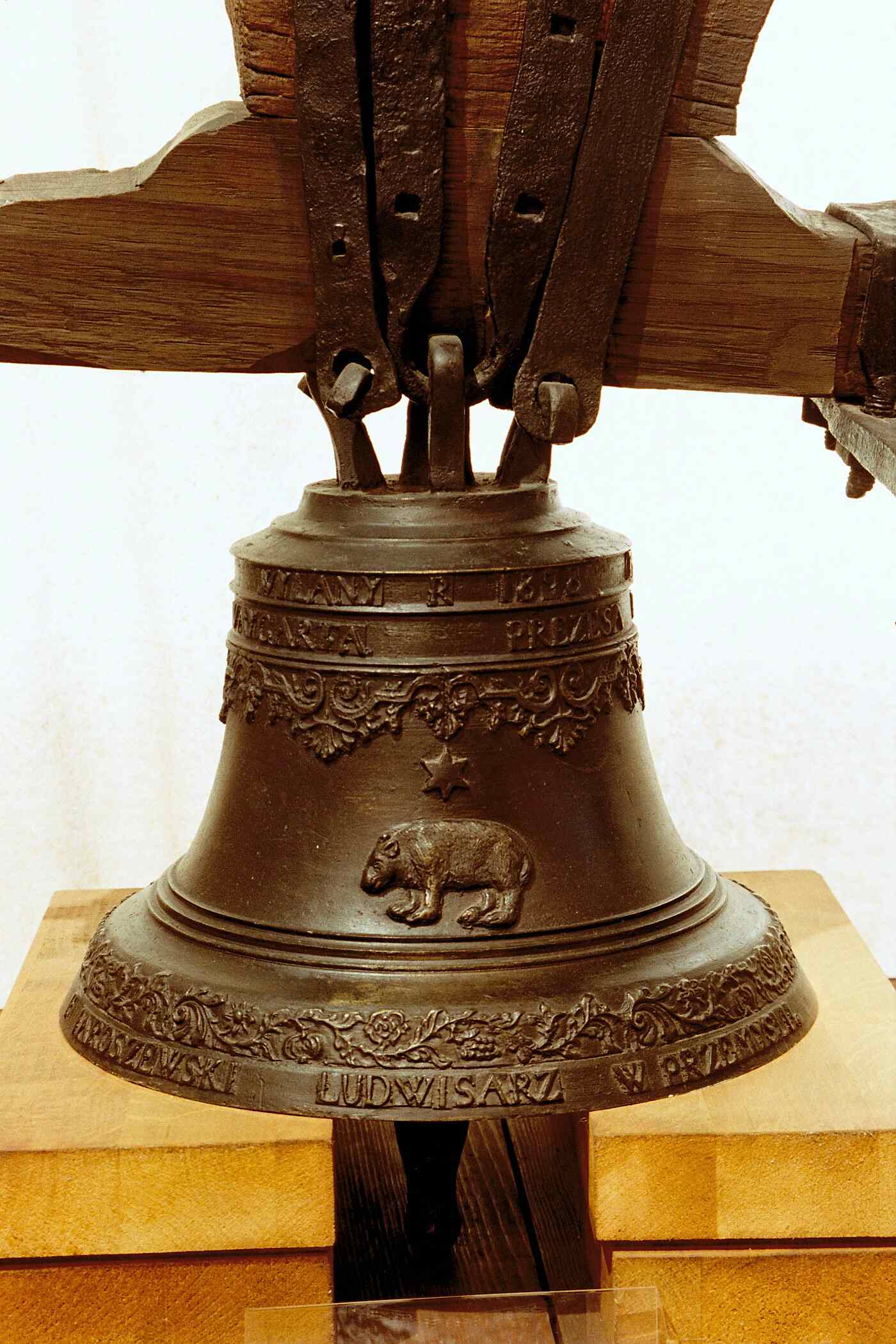
The bronze bell bears an inscription around its neck with the date: “AD 1740.” On its mantle is the Przemyśl coat of arms from the Old Polish period: a bear striding to the right, with a knight’s cross above its back, and below it are the names and surnames of the mayors in power at the time: “KAZIMIERZ GRZYBOWSKI” and “MARCIN CZEHOWICZ” (sic!). This bell was made during the Saxon era, a period when the city treasury, like that of other royal cities, was empty. Casting the bell – a rather luxurious item – was certainly not a priority for the city councilors at the time. The Przemyśl City Records, stored in the State Archives, provide a detailed history of this monument. Kazimierz Grzybowski arbitrarily ordered the bell to be made, without permission from “city hall” and without the means to pay. To reward the anonymous founders, he stole a metal pipe from the town hall’s storage room and removed a metal shutter from a town hall window. After these events, he promised the councilors to improve their condition and obtain money during the proceedings of the Crown Fiscal Tribunal in Radom. Unfortunately, in Radom, he became so drunk that he slept through the proceedings and returned to Przemyśl empty-handed.
The bell was made in 1740, the founder is unknown, and was likely cast in Przemyśl. The material and technique used are likely bell bronze, iron (heart), casting, and chiseling; dimensions: bottom diameter 29 cm, height 32 cm; cup-shaped, heart-shaped. It belongs to the collections of the National Museum of the Przemyśl Region in Przemyśl. The bell is a heavy, dark brown metal bell, shaped like an upside-down cup, with four metal bows resting on a central sleeve at the top. These form the bell’s crown. The crown sits on a slightly raised circular field. Below this field, on the arch of the chalice, are two small protrusions encircling the crown, forming small notches cast in the metal. Slightly below, beyond the arch of the chalice, the bell is encircled by two even more widely spaced notches. Between these notches, on a smooth field, are the raised letters AD, spaced quite far apart. On the opposite side of these letters, also between the notches, is the date 1740, the date of the bell’s manufacture. Below the letters AD, on the smooth part of the bell known as the mantle, is a convex figure of a chubby bear. The bear stands on all fours, facing left, and above its back is a cross with equal arms. This cross is a knight’s cross. Below the bear’s paws, on raised fields in the form of stripes, are inscriptions with the names and surnames of two Przemyśl mayors. On the long upper strip, raised letters form the inscription “KAZIMIERZ GRZYBOWSKI,” while on the slightly shorter lower strip, the same letters form the inscription “MARCIN CZEHOWICZ.” Characteristically, the surname “CZEHOWICZ” is written with a single “H.” Below the bottom of the mantle are two more raised notches circling the bell’s cup, and even lower, an arched curve at the thickest point of the cup. This thickest point is the heart ring, which the bell’s heart strikes to produce the sound. Below the heart ring is the bell’s lower edge. Unfortunately, the bell at the bottom edge, slightly to the right of the inscriptions with the mayors’ names, is significantly damaged – a significant portion of the metal has been broken off, and the continuity of the heart ring is broken. Inside the bell’s cup, suspended on a special stirrup, is a cast iron heart in the form of a mace, widening towards the bottom.