

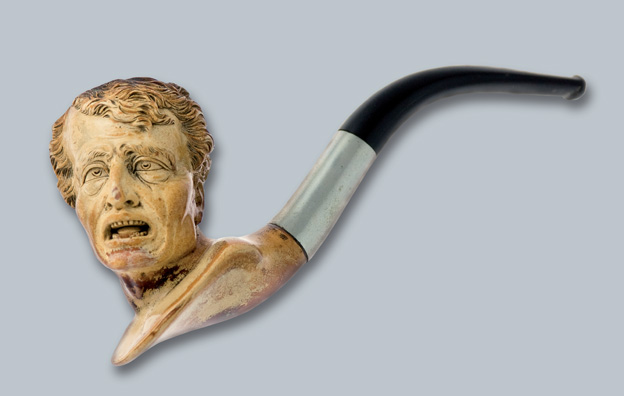
The pipe consists of a slightly tinted meerschaum bowl, a sheet metal bowl, and an ebonite mouthpiece. The bowl is a full-bodied sculpture, shaped like the bust of a mature man. The pipe likely originates from France, made in the second half of the 19th century. The secondary mouthpiece dates from the 1920s-1930s. The depiction is realistic. The facial expressions convey strong emotions evoked by pain. The figure’s absent gaze and wide-open mouth with visible teeth help us imagine his “scream.” The charred chimney mouthpiece also heightens the drama of the figure. The author utilizes dark humor – the depicted figure experiences torment each time his “head” is lit. The artist may have been inspired by seventeenth-century sculptures: Gian Lorenzo Bernini’s “The Cursed Soul” or Balthasar Permoser’s bust of “Marsyas” – a satyr from Greek mythology, punished by Apollo with cruel suffering for his pride.
Unknown manufacturer, pipe with a head in the shape of a male bust, second half of the 19th century, probably France, carved, meerschaum, sheet metal, ebonite. Collections of the National Museum of the Przemyśl Region in Przemyśl. Pipe with a meerschaum head of uneven light brown color, in the form of a full-bodied sculpture, in the shape of the bust of a mature man. The hole in the head for stuffing the tobacco is blackened at the edges. The head is turned to the right, the hairstyle is short and receding, the bangs are swept to the side, and the hair is wavy. Muscular features, with prominent cheekbones and jawline. The man’s face is full of expression, his facial expressions conveying suffering and pain, his eyes wide with raised eyebrows, his mouth open in a painful grimace, revealing his teeth and tongue. The sculpture is realistic and meticulously detailed. The lower part of the pipe is elongated and angled upwards, with a silver sheet section extending from it and a pointed tip made of black ebonite, used to draw smoke into the mouth. Pipes shaped like human and animal heads were particularly popular in Europe in the 19th century. They were also carved in wood, and made from clay pressed from a mold and then fired. The artist employed a touch of dark humor – the figure depicted “screams” in pain as the fire is lit. The author could have been inspired by seventeenth-century sculptures: Gian Lorenzo Bernini’s “The Cursed Soul” or Balthasar Permoser’s bust of “Marsyas” – a satyr from Greek mythology, punished by Apollo with cruel suffering for his pride.