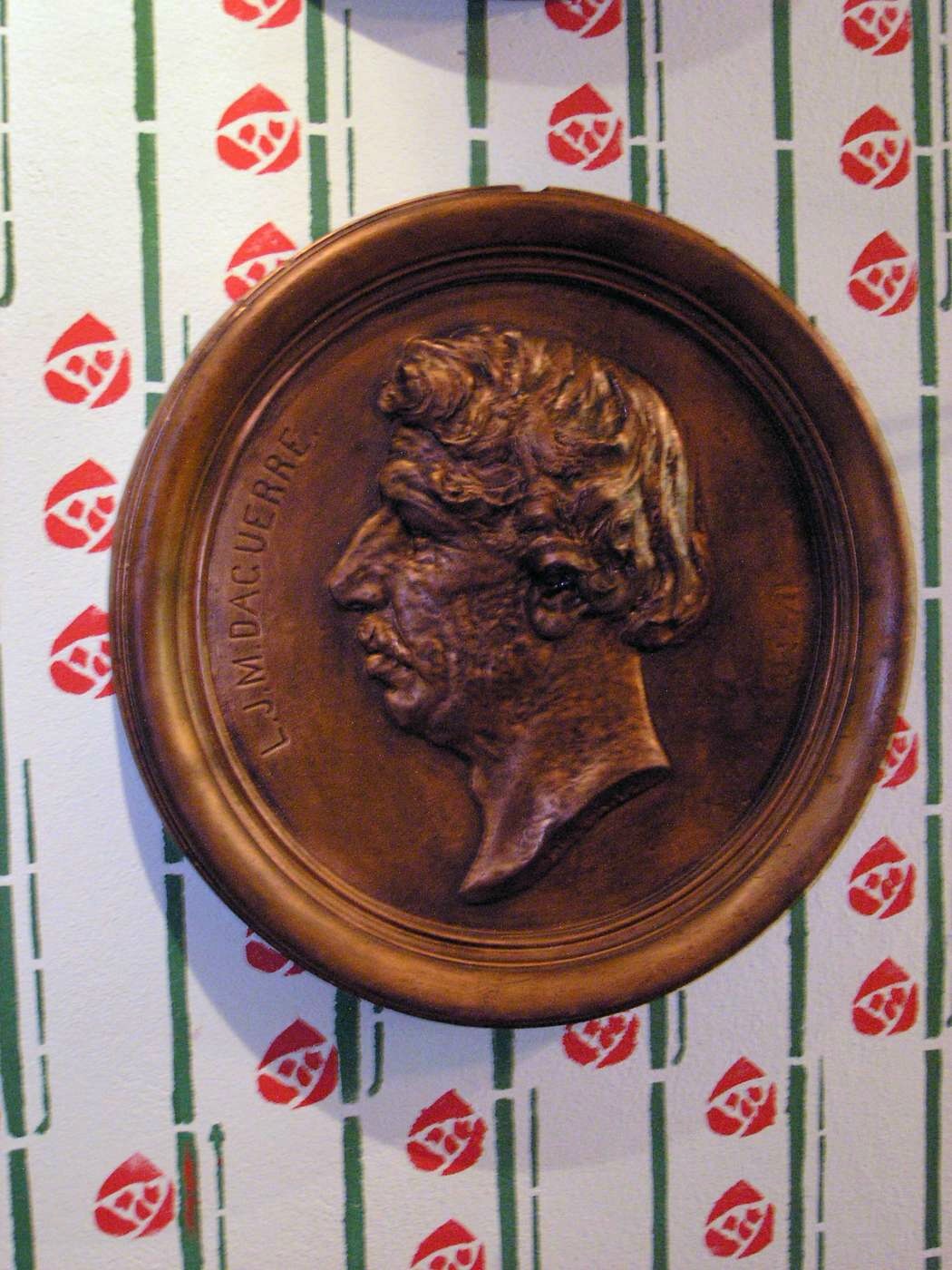
Designed by Artur Kann, Medallion with a portrait of Louis Jacques Daguerre, circa 1890, Vienna. Cast, patinated plaster. Dimensions: diameter 48 cm. Collections of the National Museum of the Przemyśl Region in Przemyśl. The oval plaque is a bas-relief cast in plaster, covered with brown paint imitating the patina of metal. The portrait is realistically rendered. In the center of the oval, against a smooth background, is a man depicted in left profile, reaching to the neckline. The man has a large, hooked nose, a mustache, and a small chin. His hairstyle includes bangs, wavy hair reaching to his ears, with half of his ear visible. He has rough skin and facial wrinkles. The medallion is surrounded by a wide, contoured frame. To the left of the subject, against the background, is a concave inscription: L. J. M. DACUERRE. The presence of this commemorative medallion in the exhibition is no coincidence. Louis Jacques Daguerre (born 1787, died 1851) was a French painter and set designer, and above all, the inventor of the first photographic technique, presented in 1839. This method was named daguerreotype after him. On the wall, next to his portrait, hangs an identical medallion with a portrait of Joseph Nicefor Niepc, Daguerre’s collaborator. He made a significant contribution to research on the new technique, but unfortunately, he died before the method was fully developed.
Medallion with a profile portrait of L. J. Daguerre