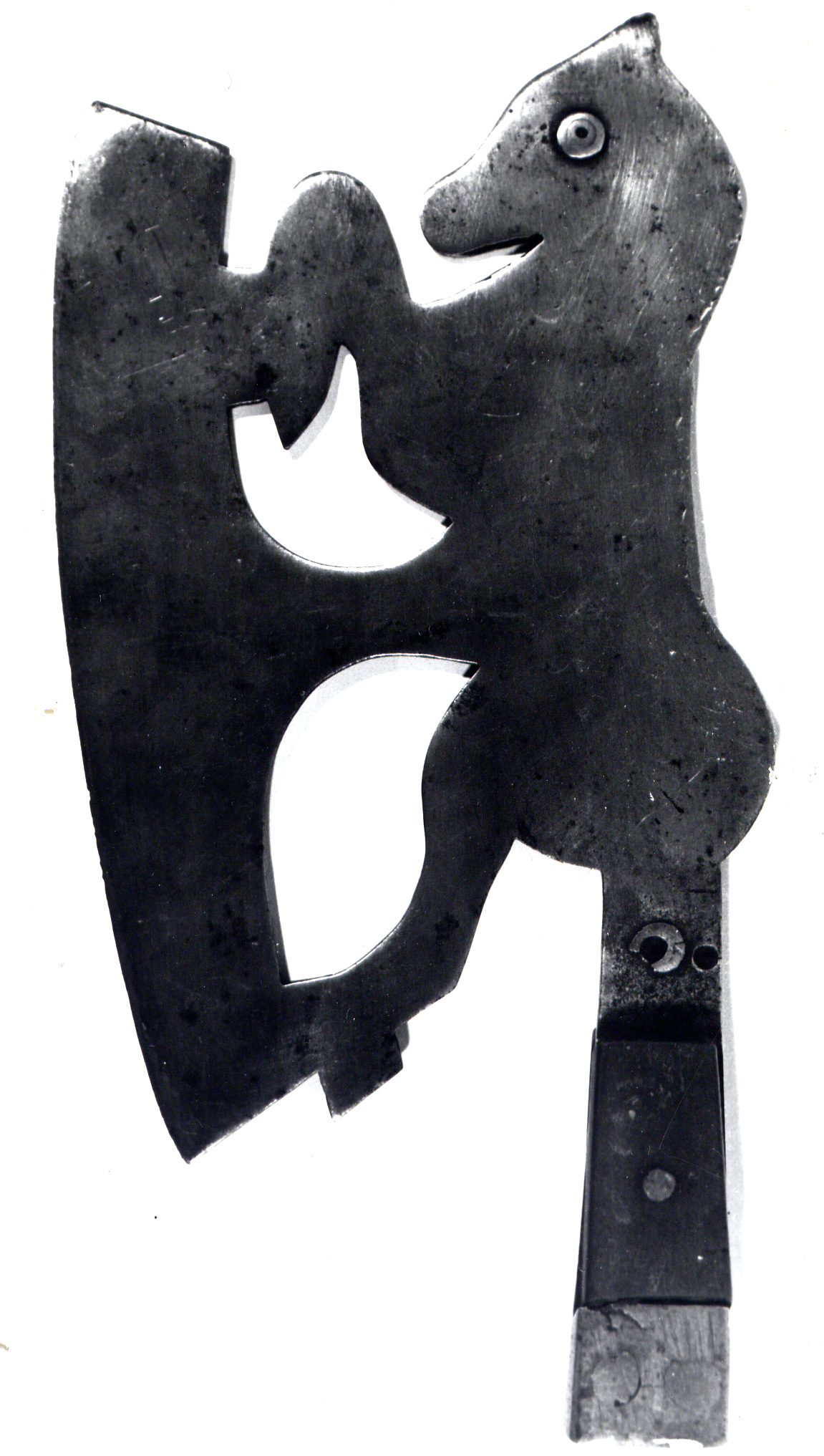
A cleaver – a meat cutting tool, consisting of a blade and a handle. Origin: Austria-Hungary, 19th/20th century, with dimensions: width: 14 cm and length: 29 cm. The wide, open-work blade is made of steel. It was carved along the contour in the shape of a running horse, with a wide, arched strip of ground beneath the legs. By cutting two holes in the surface, the shape of the legs was achieved – only three, as the front two were treated as a single unit, just wider than the rear ones. The lower edge of the strip is sharpened, creating the actual cutting surface. The wide, horizontal tail extends directly into the handle shaft. The handle is slightly flared towards the rear and has a straight tip. Flat, matching width plates are attached to the shaft. The plates are made of horn and secured with rivets. On the horse’s head, in place of the eye, an imitation of it is mounted, made of a brass rivet on a wider brass base.
Meat cleaver with horse-shaped blade