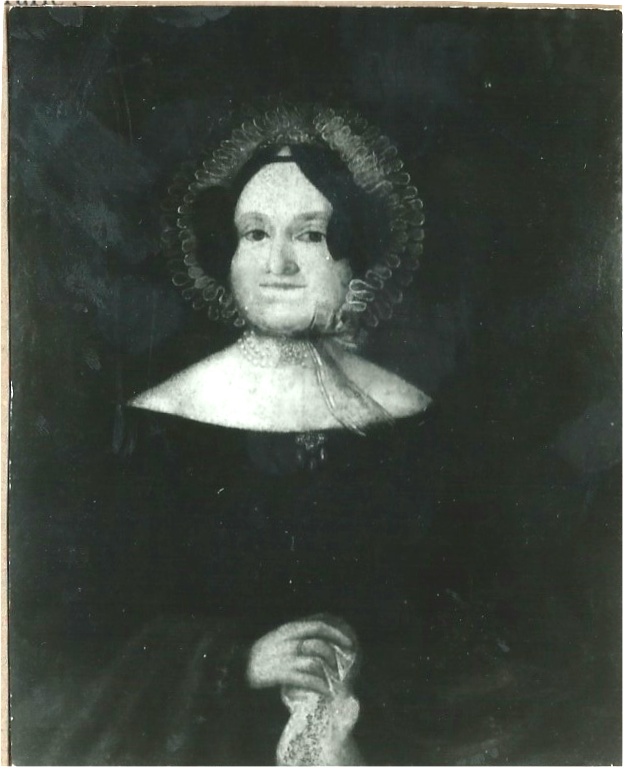
Unidentified artist (signed V. Mos.. or V. Mof…), “Portrait of an Old Woman,” first half of the 19th century, oil on canvas. Painting dimensions: 69 x 57 cm. Collections of the National Museum of the Przemyśl Region in Przemyśl. The painting depicts a woman standing straight, hip-length. The woman has a face with round cheeks, a prominent double chin, and narrow, pursed lips. She has a large nose, blue eyes, light eyebrows, and a high forehead. Her very fair, almost white complexion contrasts with her very dark brown hair. Her hair is tied in two buns on the sides of her head, at ear level. It is tied with a black ribbon above her forehead. She wears a bonnet trimmed with two rows of ruffles that frame the subject’s face. The bonnet is tied at the neck with a blue ribbon. The woman’s headdress signifies that she was married or a widow. Around her short neck is a double strand of pearls, fastened at the front with a round clasp. The woman is dressed in a black dress with a wide neckline and puffy, long sleeves. A pearl brooch is pinned to the center of the neckline. The subject holds a white handkerchief with small blue flowers, likely forget-me-nots, at waist level. A dark blue shawl is draped over her forearms. The background is very dark brown. The painting is an example of a bourgeois portrait from the first half of the 19th century. During this period (1815–1848), Biedermeier was the dominant style in bourgeois circles. It was visible primarily in furniture and residential interior design. These were intended to be functional and comfortable. Salons, like the one we’re in, were places where families gathered, where they spent pleasant moments playing music together, conversing, and entertaining guests. They were meant to be spaces characterized by understated elegance and coziness. In painting, this style was characterized by unadorned realism, a shift away from idealization of figures, simplicity, a distinct seriousness, and a celebration of family life. Portraits of entire families were common. In portraits of individual subjects, details were crucial, revealing the social status of the subject, their profession, or their wealth. The portrait described above depicts a middle-aged woman, a wealthy married woman or widow, as evidenced by the bonnet on her head and the jewelry she wore.
“Portrait of an Old Woman”