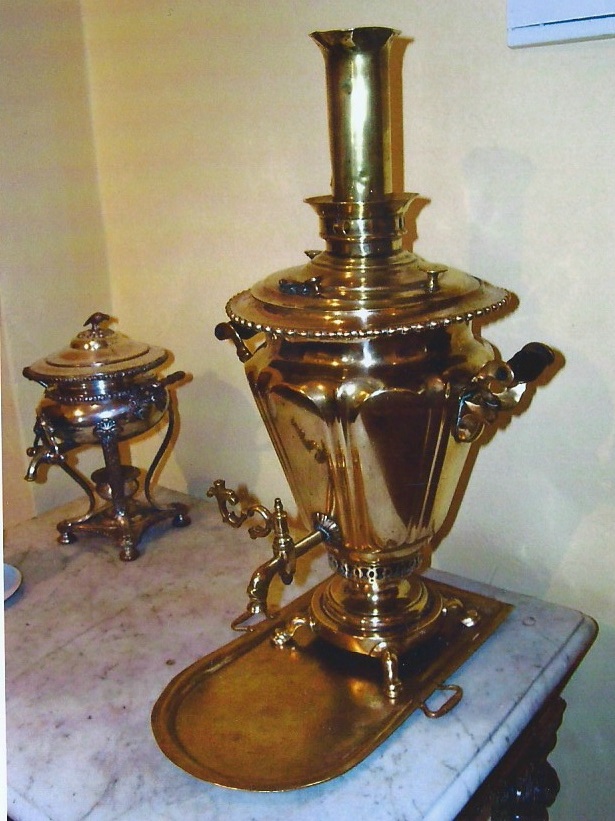
A brass samovar of typical shape, with a tray. Origin: Russia, 2nd half of the 19th century, dimensions: 60.5 cm high, 36 cm wide, 33 cm deep, with tray dimensions: 1.5 cm high, 27 cm wide, 39.5 cm deep. The base is round, contoured, supported by four arched legs. The base flows smoothly into a very short “stem” – a narrowing connecting point with the massive body. The vase-like, octagonal body widens upward and bulges to form a narrower, cylindrical neck terminating in a flat, arched “collar.” A circular charcoal grate is mounted at the bottom of the body, surrounded by an openwork air intake cover. The walls are divided into eight oval sections, further accentuated by vertical rollers. The collar edge features plastic pearls. The body is closed by a relatively flat, profiled, originally tightly fitting lid with a round opening in the center, with a raised edge. Inside the body is a vertical, fairly wide pipe connected to a charcoal burner. This creates a heater for boiling water poured into the body/tank. The pipe tapers slightly at the outlet and fits snugly into the opening in the center of the lid, protruding approximately 0.5 cm above it. A tall, brass chimney with a widened outlet is placed over the edge of the pipe to discharge exhaust gases. A widened, openwork “collar” is placed over the edge of the lid opening, on which a teapot containing the essence is placed after the chimney is removed. A tap with an S-shaped lever in the form of a plant twig is attached to the bottom of the body to release the water from the tank. A poorly legible factory mark is stamped on the tank lid: a symbol resembling tongs in a circle, and beneath it the letters, probably E A. The samovar sits on a matching tray, also made of brass, in the form of an elongated rectangle, with one of the shorter sides rounded and a rather high, flared edge. Decorative, cast loop handles are riveted to the center of the longer sides.
Samovar with Tray