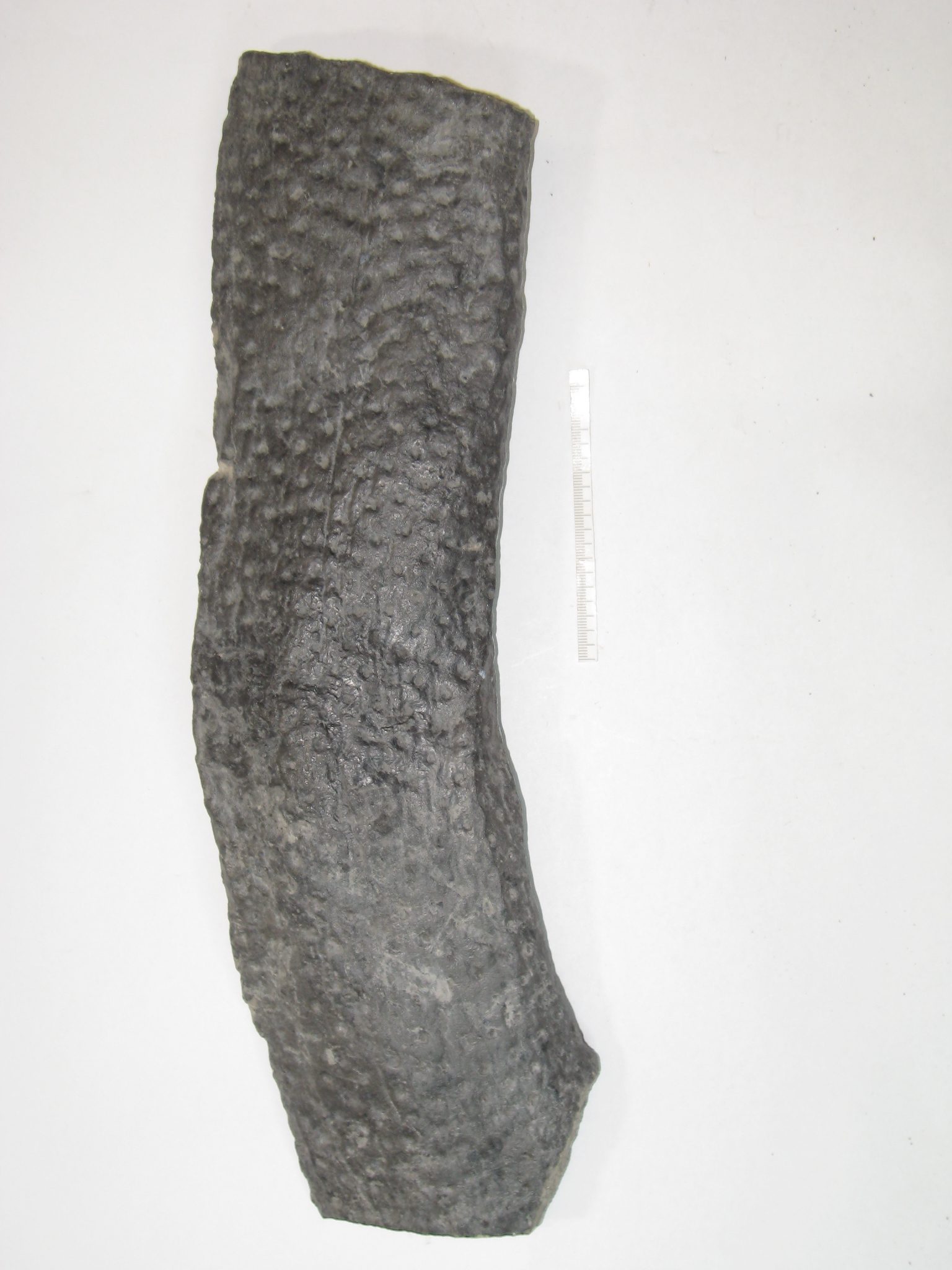
Sigillaria (Latin: Sygillaria) – a fossil, also known as a seal tree. This vascular fossil plant belongs to the order Lepidodendraceae. This extinct genus of tree-sized clubmoss lived during the Carboniferous Period (360–300 million years ago). Carboniferous clubmoss had large trunks. The interior of the trunk was not strongly woody, containing very little wood and often being hollow. Therefore, sigillaria preserved in hard coal, as fossils, are not preserved in a cylindrical shape, but as strongly flattened, flat “boards” with characteristic ornamentation. The presented Sigillaria specimen is a natural fragment of a plant fossil in the form of a flattened, stone trunk, 41 cm long, 11.5 cm wide, and 3.7 cm thick, black in color. Its shape resembles a charred, flat log with a rough surface covered with scars, almost regularly arranged. These are preserved imprints of leaf attachment points. The leaves were placed on leaf pads. These pads are preserved as circular marks left on the trunk surface after the leaves had fallen. These regular indentations and bruises resemble stamps in their appearance, hence the name “seal trees.” The remains of these plants played a significant role in the formation of coal seams.
Sygilaria