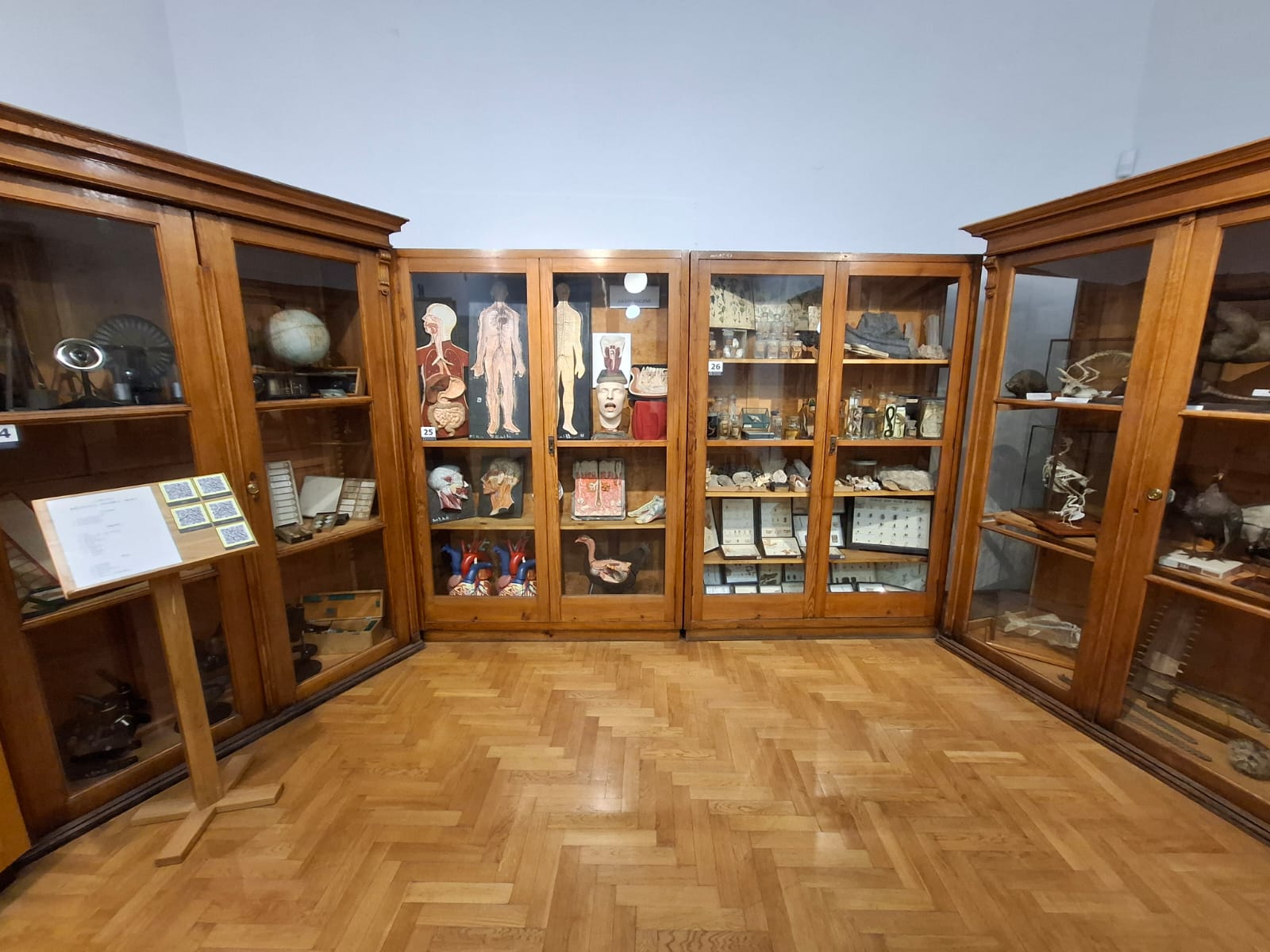
In the main room of the Former Classroom, on the right, there is a display case and cabinets from the early 20th century containing teaching aids from the former school’s subject-specific offices. The case contains geological specimens. They include colorless rock crystals, purple amethysts, and milky quartz. Next to them are minerals: salt (white, red, and black), yellow native sulfur, gypsum, brown ozokerite, and brick-red hematite. Green malachite and azurite, as well as fragments of various flints, along with limestone desert rose and polished marble squares, complete the display case’s interior. The first cabinet on the top shelf houses teaching aids for physics. Among the more interesting items are an electrostatic machine (Wimshurst) from the early 19th century, an ammeter, and a model of a pile driver—a device for driving piles—from the physics lab of the Imperial-Royal Junior High School in Przemyśl (1st Secondary School). Next to it are geography teaching aids: a globe from the Urania Joint-Stock Company and a barograph from the Parisian firm of Richard Feres from the late 19th century. Below are microscopes from the Viennese firm of C. Reichert from the turn of the 20th century, as well as later ones from the Polish Optical Works. Microscope slides are also available, among others, from the Lviv and Krakow workshops of Dezydery Szymkiewicz (1885-1948) and the “Urania” Warsaw Scientific Aid Factory. Another display case contains unique plaster models, now unique and exceptional, that for half a century served Przemyśl students to explore the secrets of human anatomy. They come from the Leipzig Scientific Aid Workshop. They were created by the sculptor Franz Josef Steger (1845-1938) under the supervision of the anatomist Carl Ernst Bock (1809-1874). The anatomical plaster models on wood, dating from the early 20th century, are signed by Václav Frič, founder of a wholesale teaching aids store in Prague. Currently, they can only be admired in a very few museums. The next cabinet contains teaching aids from botany and zoology, which were used to furnish natural history labs, including natural history specimens in the form of permanent animal skeletons, stuffed specimens, display cases of insects, and various wet formalin preparations. Behind the laboratory scales is an original fume hood, converted into a chemical cabinet with reagents and laboratory equipment. All the exhibits were originally used in Przemyśl’s Imperial-Royal grammar schools and realschules.
Teaching Aids