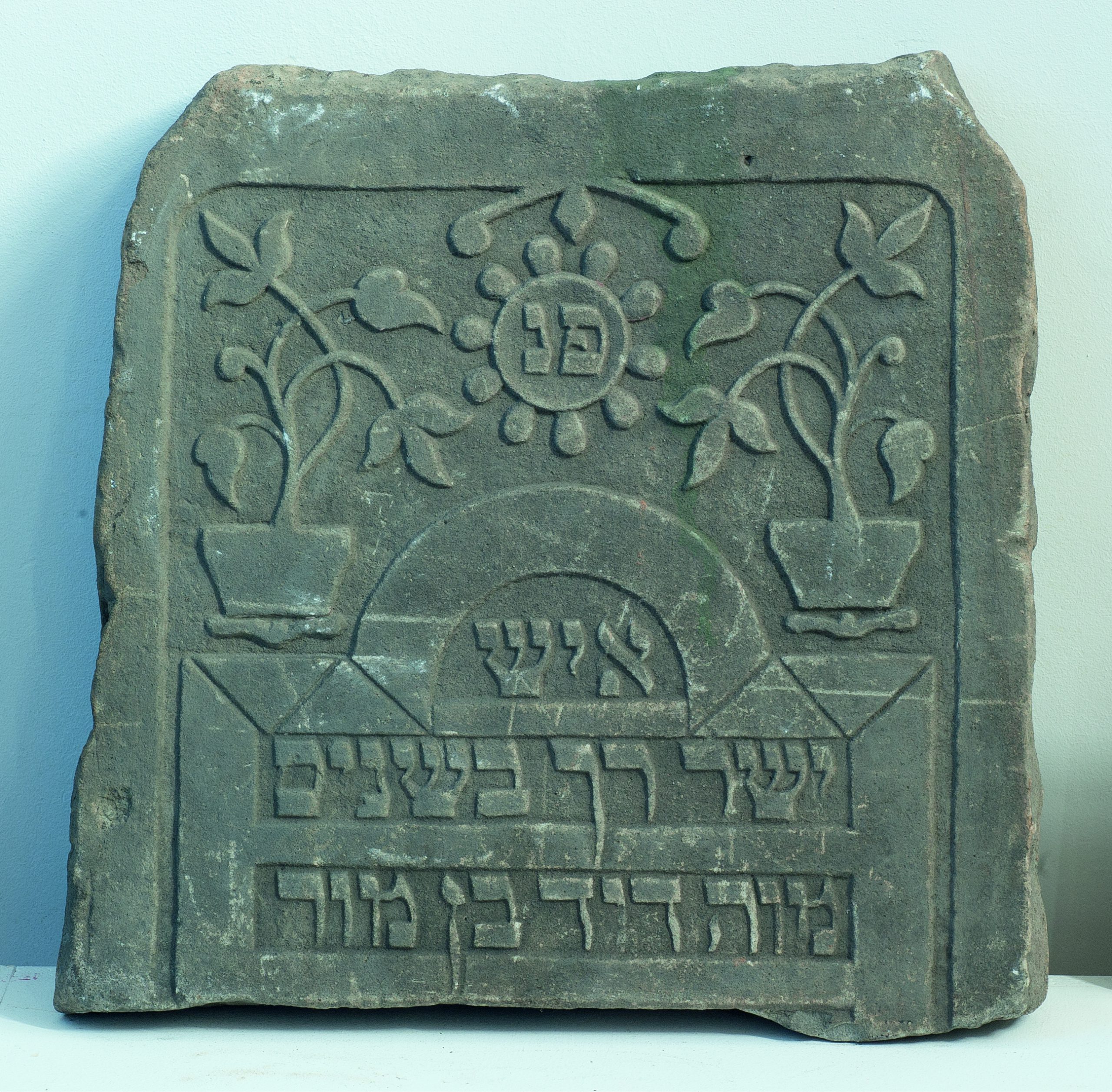
Matzeva – a modest grave monument, shaped like a vertical slab. The matzevah on display is actually a fragment of the upper part. It was created in the 19th century, in an unknown workshop – likely in Przemyśl. Made of sandstone. On the front, it has a carved relief with plant motifs at the top, and an inscription in Hebrew. The inscription, roughly translated, reads: “Here lies an honest man who lived to a ripe old age, David son of Mor.” The only decoration on this matzevah are two plants – probably vines – shown in pots. Between them is a round medallion resembling a sun. On it are two Hebrew letters, abbreviating the phrase “Here lies.” Symbols in the form of representations of objects and animals were also placed on the matzevahs, revealing much about the identity of the deceased. Here are just a few examples: a grapevine – a symbol of the people of Israel; a bird – symbolizing a chaste woman; a deer – a male name like Tzvi, Hirsh, or Naftali; two raised hands – symbolizing a priest; books – signifying a scholar or rabbi; a money box – a person generous to the poor. Another matzevah in the exhibition is a perfect example of symbolic representation. Notice the stone slab with a bird holding a twig in its beak. The buried person was likely a young woman, and the broken twig symbolizes her sudden death. The matzevahs presented in the exhibition survived in fragments, discovered accidentally in Przemyśl after the end of the war. They, too, may have been the targets of devastation caused by anti-Semitism.
A Jewish tombstone with a Hebrew inscription and plant motifs.