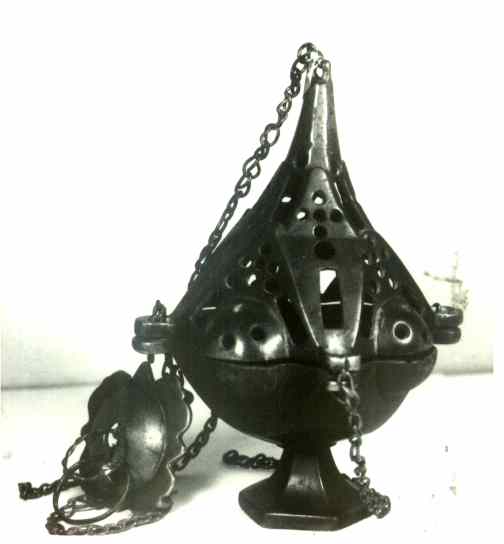
A thurible – a censer used during church liturgy. It was cast from a copper alloy, probably bronze. It essentially consists of two parts – a ember bowl supported by a base and a cover with a handle, connected by chains. The base is hexagonal, five centimeters in diameter, with clearly defined edges. It flows smoothly into a low shaft, also hexagonal, tapering towards the top. At the end of the shaft is a small flat disc, called a saucer. The bowl has a rounded bottom, and the walls are octagonal in shape, with longer and shorter sides. To an outside observer, it looks as if someone had cut out some of the walls in a round bowl, inserting straight sections shaped to fit the holes, i.e., close to a semicircle. Small conches are formed in the center of the straight walls near the edge, protruding outward, forming a quarter of a sphere. On the edge of the bowl, above the rounded sections of the walls, are semicircular chain holders with round holes for attachment. The openwork cover resembles a truncated pyramid, resting on a square base with chamfered corners and an octagonal finial. It is fitted to the bowl at the edge, with identical chain holders and protrusions in the center of the sides. The surfaces above the corners widen upwards towards straight edges. They meet along their entire length with the triangular sides of the cover. The tops of the sides are slightly rounded. The top is high, in the form of a pyramid on an octagonal base, with a different angle of inclination than the cover, with a change in inclination and width of the walls at mid-height. The walls of the lower part vary in shape and size; they are narrower and rectangular above the apex, and above the extensions, they are triangular with chamfered corners. The walls of the upper part are almost identical, with a semicircular chain holder formed at the top. Beyond the upper part of the finial, the lid features slightly irregular ventilation holes, known as smoke holes. The smaller ones are circular, the larger ones rectangular. The censer’s handle is in the form of a small dome with a flat, square rim, cut into arches. Two circular holes are cut into the dome, through which the chains are threaded. Two chains are preserved, one of which passes through two pairs of handles in the bowl and lid, and the other is attached to the handle in the finial. Both are terminated in large rings, visible above the holes in the handle.
Censer