

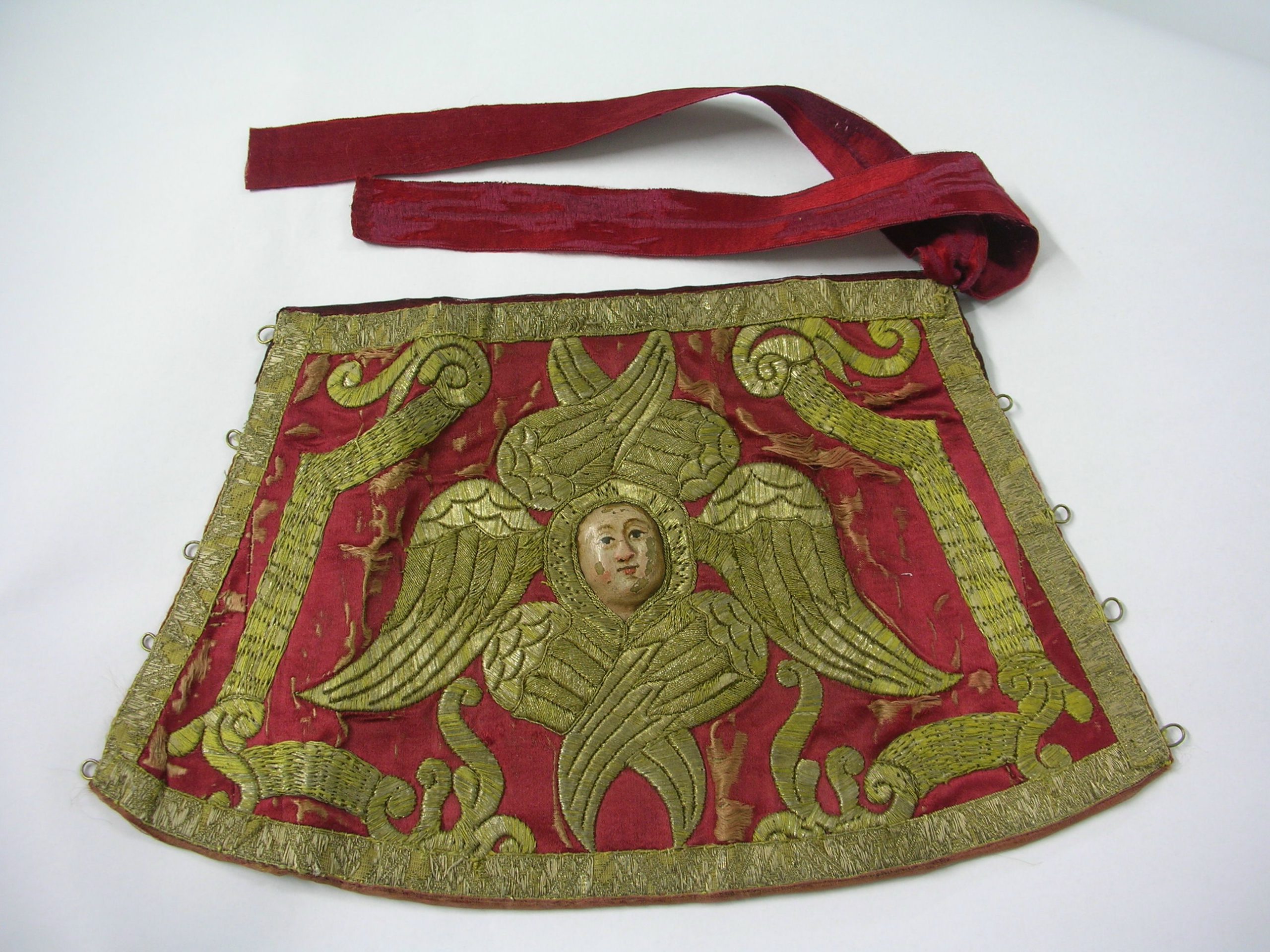
Epimanikia, or sleeves, are elements of the liturgical vestment worn by the clergy in Eastern Rite churches. They are worn over the sleeve ends of the sticharion (or alb). The presented epimanikia consists of a pair, made in the first half of the 18th century, from the former cathedral of the Greek Catholic Eparchy of Przemyśl. The artifacts were donated to the museum after World War II by the Discalced Carmelites in Przemyśl. Liturgical vestments and vestments (paraments) in the Catholic Church have a specific order and symbolic meaning. Epimanikia symbolize the divine power that surrounds the “soldier of Christ.” They also allude to the shackles placed on Jesus during his captivity. The presented crimson-colored epimanikia was a set of the same-colored vestments worn during the most important holidays and celebrations. A richly decorated epimanicium, made of silk, with embroidery on a base of silver-gold metal threads. In the center is the image of a seraph—an angel with three pairs of wings. The convex head is made of hardened wax, and the face is painted with paint. The head is surrounded by a halo. This pair of epimaniciums has undergone a thorough renovation.
Unknown workshop, epimanicium with a seraph, first half of the 18th century, probably Poland, embroidery, hand-sewn, wax appliqué hardened with paint, silk, canvas, galloon, brass. Dimensions: length 19 cm, width 31 cm. Collections of the National Museum of the Przemyśl Region in Przemyśl. The unfolded epimanicium has a trapezoidal shape. The top is made of smooth silk fabric with a red sheen. In the center is embroidery depicting a seraph, or angel with three pairs of wings. The seraph’s head is convex, made of hardened wax. The face is painted with paints. The head is surrounded by a halo. The embroidery has a convex structure resembling a relief, executed with gold-colored metal threads. Both sides of the seraph are decorated with broken strips connected with curled floral motifs. A galloon, a ribbon woven from metal threads, is sewn onto the edges of the epimanicium. The side edges feature metal rings for threading the ribbon that ties the epimanicium around the arm. Epimanicium, or sleeves, come in pairs and are part of the liturgical vestment worn by clergy in the Greek Catholic Church. The epimanicium on display also comes in a pair. Richly decorated, they are the most beautiful pieces in the museum’s collection. They come from the former Greek Catholic cathedral in Przemyśl.