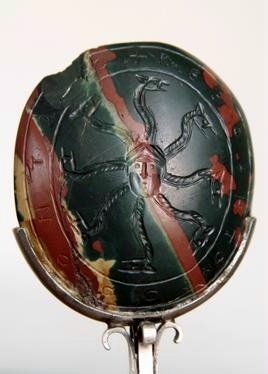
The gem presented here is a type of magical, even magical-medicinal gem. Its content contains magical elements dating back to ancient beliefs, as well as references to Christianity in the formula of an invocation to the Lord, implicitly Christ, and the image of the Virgin Mary. The spell is directed at the uterus, which, in contemporary medical beliefs, was considered an organ functioning in both women and men. It could move freely within the body and cause various ailments, from stomach aches to headaches and various nervous disorders. The head surrounded by snakes is a representation of this sinister uterus. The Virgin Mary likely acts as an intermediary between earth and heaven, supporting the invocation to Christ and perhaps the healing power of the amulet. Although magic was officially banned by the Church, the faithful in many cases disregarded this prohibition. Considering that official medicine continued to perpetuate the belief in the healing powers of stones and other strange substances for a long time, this is not surprising. This belief likely explains the use of heliotrope, a stone that was associated with astrology, while the spots on its surface were meant to symbolize the blood of Christ. Jeffrey Spier, one of the leading experts on Byzantine amulets and jewelry, conducted comparative analyses to confirm the gem’s Byzantine origins and dated it to the Middle Byzantine period, i.e., the 10th–12th centuries. The gem was found in Przemyśl in 1897 on Władycze Street, on land that had belonged to Przemyśl’s Vladykas—Orthodox bishops—for several centuries. It is unknown how the amulet came to our city, but it undoubtedly belongs to the period of its ownership by Ruthenian princes, who had various contacts with the Byzantine Empire.
Gemma