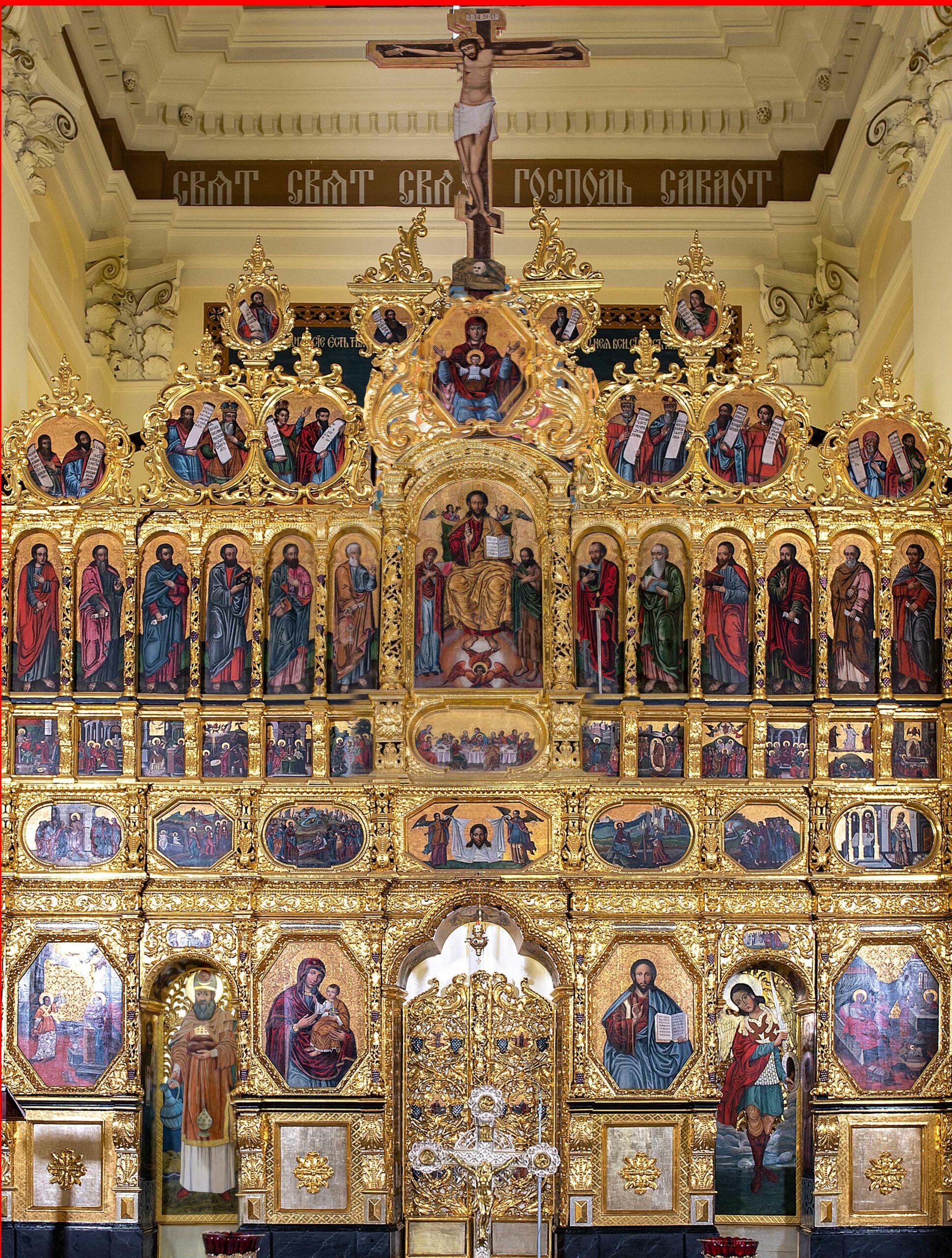
Iconostasis diagram – a tactile plaque based on a photograph of the iconostasis in the Byzantine-Ukrainian Archcathedral of St. John the Baptist in Przemyśl. The outermost icons, added vertically on both sides around 2000, have been omitted. Introductory information: The iconostasis in an Orthodox church separates the nave, where the faithful gather, from the sanctuary, where the altar is located and the liturgy is celebrated. Symbolically, the iconostasis is a wall that separates earth from heaven, as the sanctuary is the most sacred place in the church. The iconostasis is a boundary that both divides and unites. It physically separates, yet unites, because the icons in the iconostasis are like windows open to heaven. Through contemplation of icons, the faithful can commune with the Absolute. The origins of the iconostasis were a low balustrade that separated the nave from the altar in early Christian basilicas. In Byzantium, this balustrade evolved into a templon – a structure in which columns were attached to the balustrade, and a horizontal beam (architrave) connected the columns at the top. Over time, icons with images of Christ, the Virgin Mary, and saints began to appear above the balustrade, between the columns. Meanwhile, on the horizontal beam of the architrave, a depiction of Christ appeared, flanked by the Virgin Mary and St. John the Baptist. This representation was called the Deesis. Between the central columns of the templon was the entrance to the altar, known as the Royal Gate, and later, in the Eastern Church in Slavic countries, it was called the Tsar’s Gate. The transformation of the Byzantine templon into a high iconostasis took place in Muscovite Rus’ in the 15th century. Meanwhile, in the eastern lands of the Polish-Lithuanian Commonwealth, high iconostases appeared under the influence of the Balkans and Moldavia in the 16th and 17th centuries. Iconostases in Orthodox churches in the Przemyśl region. The traditional high iconostasis, which had been used in Orthodox churches in the former Przemyśl region since the 17th century, consisted of numerous icons arranged in a specific order within a wooden structure. Three entrances lead behind the iconostasis into the sanctuary. These are: in the center, on the altar axis, the double-leafed royal doors, and symmetrically on the sides, the single-leafed deacon doors. The royal doors typically depicted the four Evangelists and a scene of the Annunciation at the top. Above the lowest structural elements, which serve as a balustrade/pedestal in the iconostasis, is a horizontal row of icons called vicarage or local icons. These include, between the royal and deacon doors, icons of the Virgin Mary and Christ Pantocrator, and on the right side, a church icon depicting a saint or event associated with the church’s dedication. On the left side, an icon of a saint very popular in the given region. In the Przemyśl region, this is most often an icon of St. Nicholas. In the iconostasis from the Archcathedral Cathedral in Przemyśl, above the row of icons for the Sundays of Pentecost, an additional row of icons, not always found in iconostases, was introduced. This row consists of seven icons, with the Mandylion icon in the center, above the Tsar’s Doors. Above the icons for the row of icons for the Sundays of Pentecost, usually placed above the icons for the row of icons for the Sundays of Pentecost. These icons illustrate the most important feasts of the liturgical year, and there are at least twelve of them, most often with the Last Supper at the center of this row. The most important row in the iconostasis conceptually is the Deesis row. This term denotes a prayer of supplication, adoration, or intercession, and the most significant figures in this representation are Christ Pantocrator in the center, with the Virgin Mary turning toward him to his right, and St. John the Baptist to his left as intercessors. The Apostles are depicted as intercessors in Carpathian iconostases, six on each side. Above the row of Deesis, prophets are often depicted in medallions crowning the iconostasis, and at the center of this crowning is the scene of the Crucifixion. In this scene, the figure of Christ and the figures of Mary and St. John the Evangelist from the cross are painted, as figurative sculpture is not found in Eastern churches. In the iconostasis from the cathedral, the image of Our Lady of the Sign is also depicted on the vertical axis, at the foot of the cross. Deviations from the traditional arrangement of icons in the iconostasis most often occurred on the vertical axis, above the royal doors.
Iconostasis