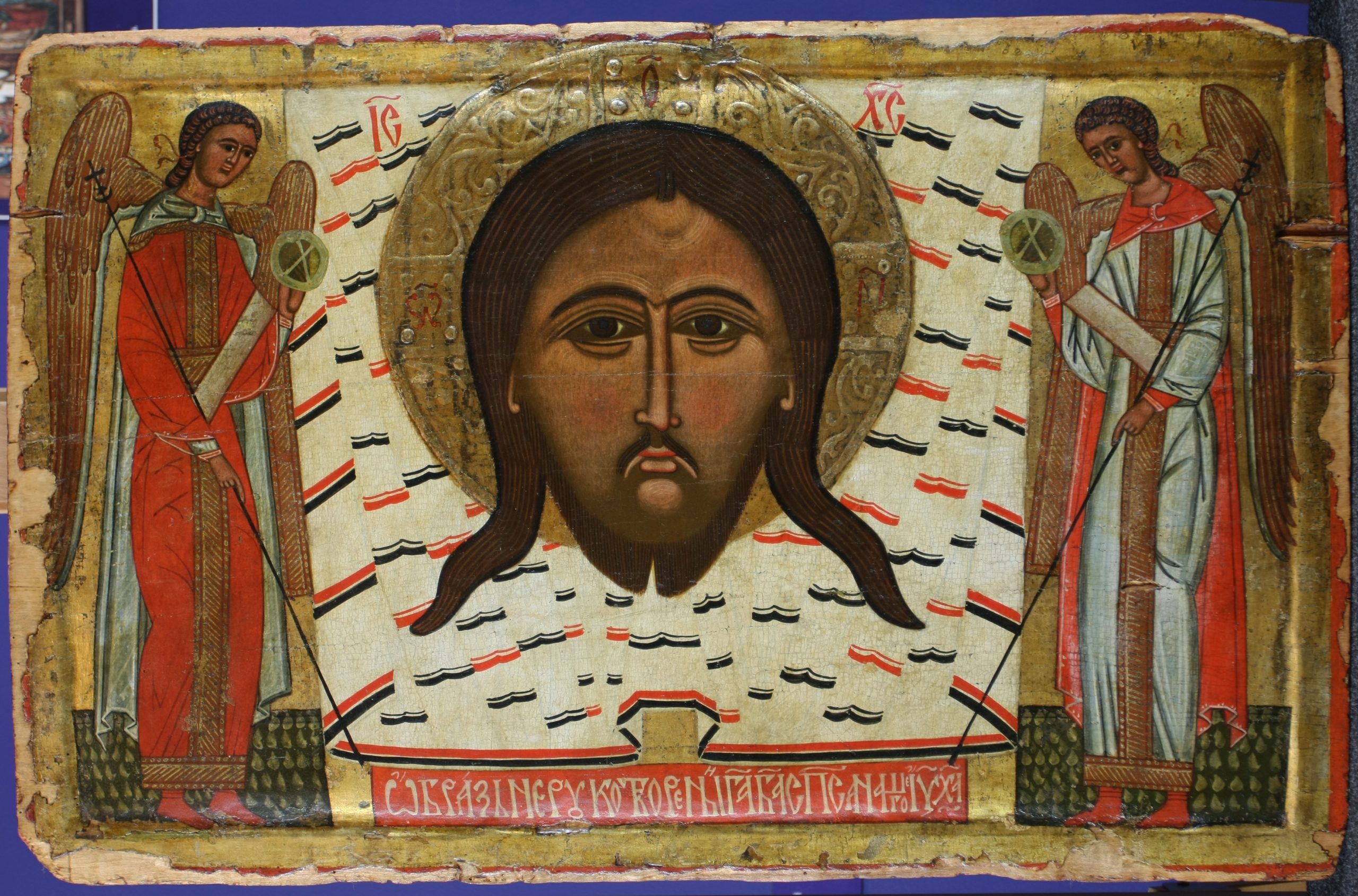
In Greek, the word mandylion means “veil.” In Eastern Church iconography, this term refers to an icon whose now-lost original was created by imprinting Christ’s face on a linen cloth. According to tradition, this cloth thus gained healing power and healed, among others, Abgar, King of Edessa. The similarity between Christ’s features, depicted on the oldest mandylions painted in the 10th century, and the Face of God from the Turin Shroud is astonishing. The Mandylion from the village of Welykie near Dobromil depicts Christ’s face, surrounded by a cross halo, on a pleated cloth stretched between the ornately robed archangels Michael and Gabriel. The depiction of Jesus’ face fills a significant portion of the icon’s kovcheg (recess). The word kovcheg in Old Church Slavonic means ark, thus symbolically alluding to the Old Testament Ark of the Covenant, guarded by two cherubim. The horizontally elongated Mandylion icon was placed on the vertical axis of the iconostasis above the Tsar’s Gates and symbolized the establishment of God’s Covenant with humanity and the Redemption. Because it was not originally painted by human hands, it was referred to in Greek as Acheropoietos and in Russian as Spas Nierukotwornyj. In the Velyki icon, the cruciform halo of Christ is gilded and adorned with relief decorations found in 16th-century artifacts. The icon was acquired in 1945 from the Ukrainian Museum “Stryvihor.”
“Mandylion” icon