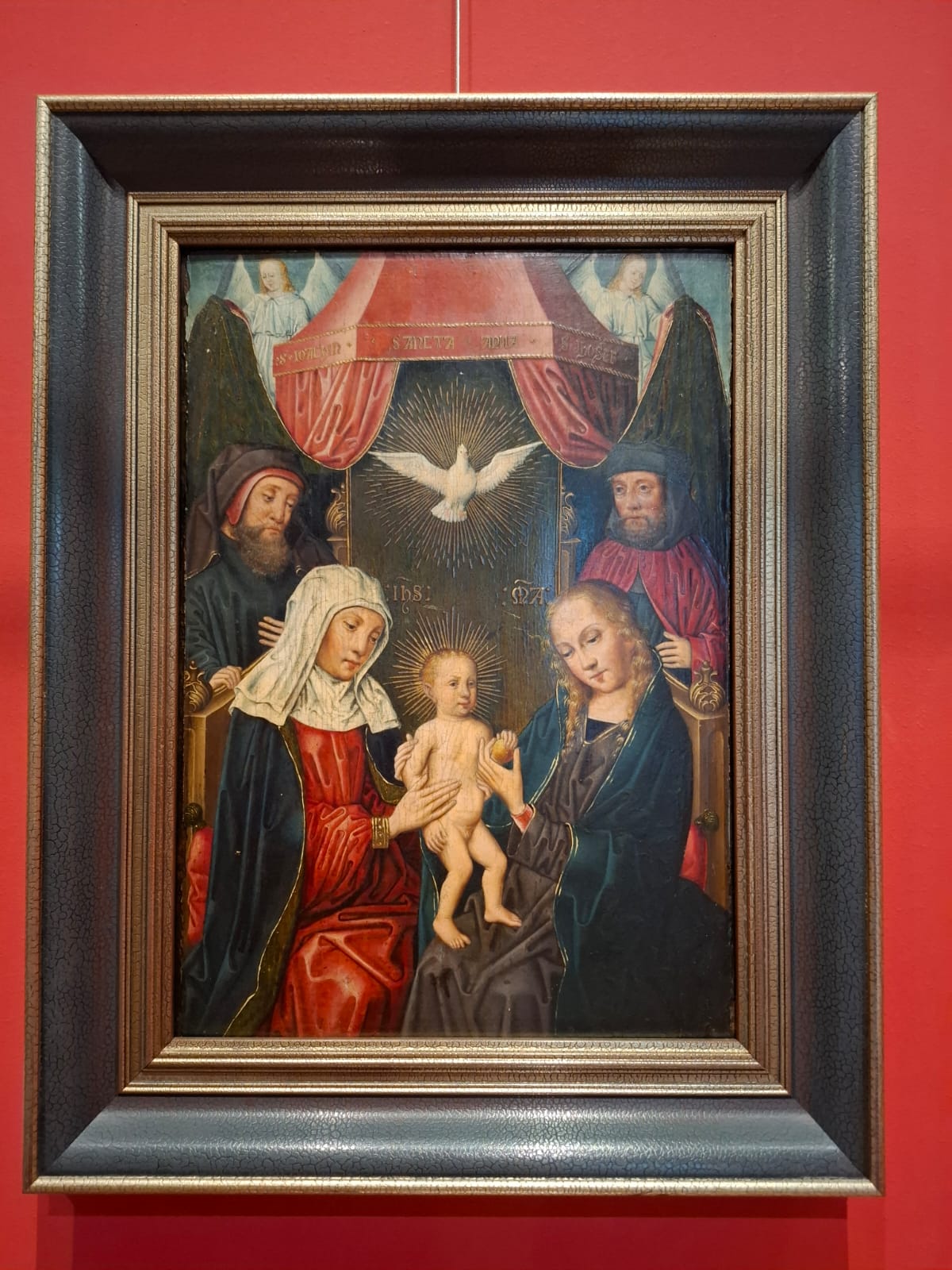
The painting “The Holy Family” is the only example of Netherlandish panel painting in the collection of the National Museum of the Przemyśl Region. The work was executed by an unknown artist in the second half of the 15th century, painted in tempera on oak panels. It is a painting with a very calm and thoughtful composition, in which there are no unnecessary elements, and every detail plays its role. The composition is dense, enclosed within a vertical rectangle, almost having the character of a theatrical stage, emphasized by the gesture of the curtains raised by the angels. In the foreground, on a wide throne with a high back covered with a red tented canopy, sit Saint Anne and Mary. Both hold the naked Child standing on the lap of the Virgin Mary, forming the group of Saint Anne of Samothrace. Note the graceful reclining of Mary’s body, reminiscent of the so-called style of beautiful Madonnas in Gothic sculpture, characterized, among other things, by the elegant, “S-shaped” curvature of the Virgin Mary’s figure holding the Child. In the painting, Mary offers Jesus fruit, a symbol of the forgiveness of original sin. Jesus’ unrestrained, undisguised nudity is meant to emphasize his humanity. The infant Jesus forms the axis of the composition, extended by the Dove of the Holy Spirit hovering above his head. Two men stand on either side of the throne’s backrest, behind the women’s backs. The one on the right is St. Joseph, while on the left, behind St. Anne, stands St. Joachim. Inscriptions on the edge of the canopy and above the heads of Mary and the Child help identify the figures. Looking at the composition of the painting, its order and symmetry are striking. The individual figures are defined by lines that intersect at the Dove, which connects the heavenly and earthly worlds. It is the Dove that indicates that the naked boy frolicking on his Mother’s lap is the Son of God, the Messiah who will erase original sin. It is worth noting the head coverings of the men and St. Anne’s headdress includes a felt cap worn over a hood for St. Joseph, a red bonnet covering the ears and additionally covered with fabric for St. Joachim, and a white scarf with a tuck on the head for St. Anne. Such headgear was worn in northern Europe in the 15th century.
The Holy Family panel painting, Netherlands