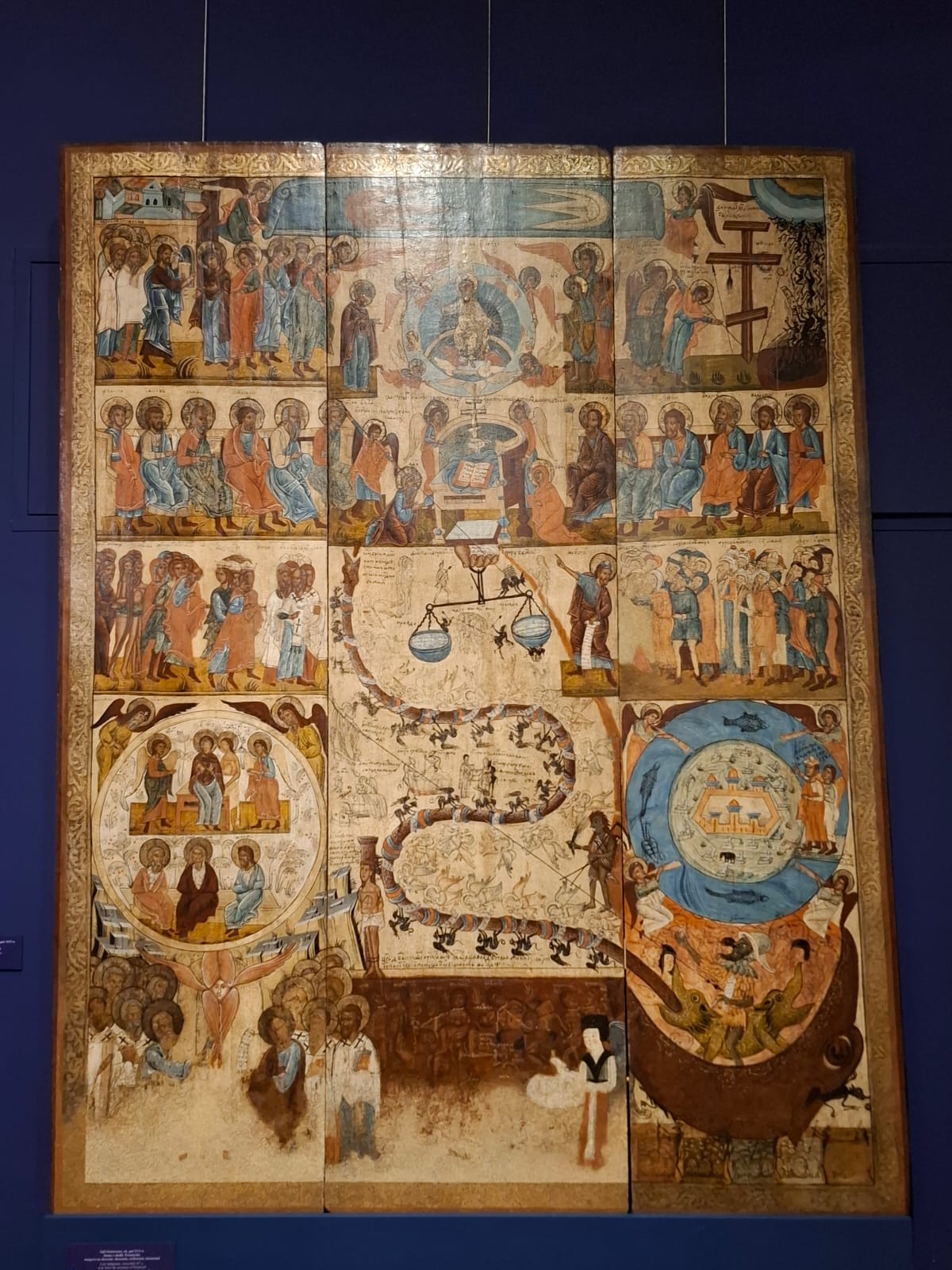
The icon of the Last Judgment was usually very large and placed outside the iconostasis. Its iconography is very elaborate – it explains the history of salvation, is based on various literary and pictorial sources, and consists of many scenes arranged in zones. The narrative of the depiction begins in the uppermost zone with two Angels rolling up a roll of heaven dotted with stars and planets. This form briefly and symbolically depicts the end of the world. In the upper left corner of the icon, Christ greets Mary at the gates of Heavenly Jerusalem. In the opposite corner, the Cross is depicted as a tool of redemption and, at the same time, as the punishment for the sin of pride – the first sin in the universe – the condemnation of Lucifer and his companions to hell. Below, in a spherical mandorla carried by four Angels, is visible the Parousia Christ, dressed in a luminous robe, depicted as the Savior on Power. On either side of him, in humble poses of intercessory prayer, stand Mary and Saint Joseph. John the Baptist – the most important intercessors, forming the Deesis trimorphion group (Deesis composed of three figures). Christ, as judge, is to sit on the Etimasia – the throne prepared for Him, to judge humanity together with the Apostolic College. From beneath the Etimasia, on which the Dove of the Holy Spirit, the Cross, and the Book of the Gospels appear, and which Adam and Eve kneel in adoration, emerges the Hand of God holding the Scales of Souls. To this Scales, along the Serpent of Sins, souls journey, undergoing the process of purification; at each ring, the devil presents a list of sins, and an angel a list of good deeds. The Apostles are gathered on either side of the Etimasia, and in the area below, on Christ’s right – choirs of the saved, and on the left – the damned nations, to whom Moses points out the Christ in whom they had not believed. Even lower, on the right, is a symbolic representation of Paradise as a garden within a circle, where Mary, adored by angels, and the Good Thief Dismas reside, along with the three patriarchs Abraham, Isaac, and Jacob, holding the souls of the saved in the laps of their cloaks. This is the so-called Bosom of Abraham. The circle of Paradise corresponds compositionally to the circle of the earth on the right, and around it, angels blow trumpets, the sound of which raises the dead from their graves. In the lowest zone, below Paradise, is a depiction of the gate of Paradise guarded by a cherub. Saints Peter and Paul and the saved stand before the gate. The center of the lowest zone and the right side are occupied by scenes of hellish torment and an image of the Abyss with the fire-breathing mouth of the Gehenna monster, a two-headed dragon, and Satan with a damned soul on his knees. The icon comes from the collections of the Ukrainian Regional Museum “Stryvihor.”
“The Last Judgment” icon