

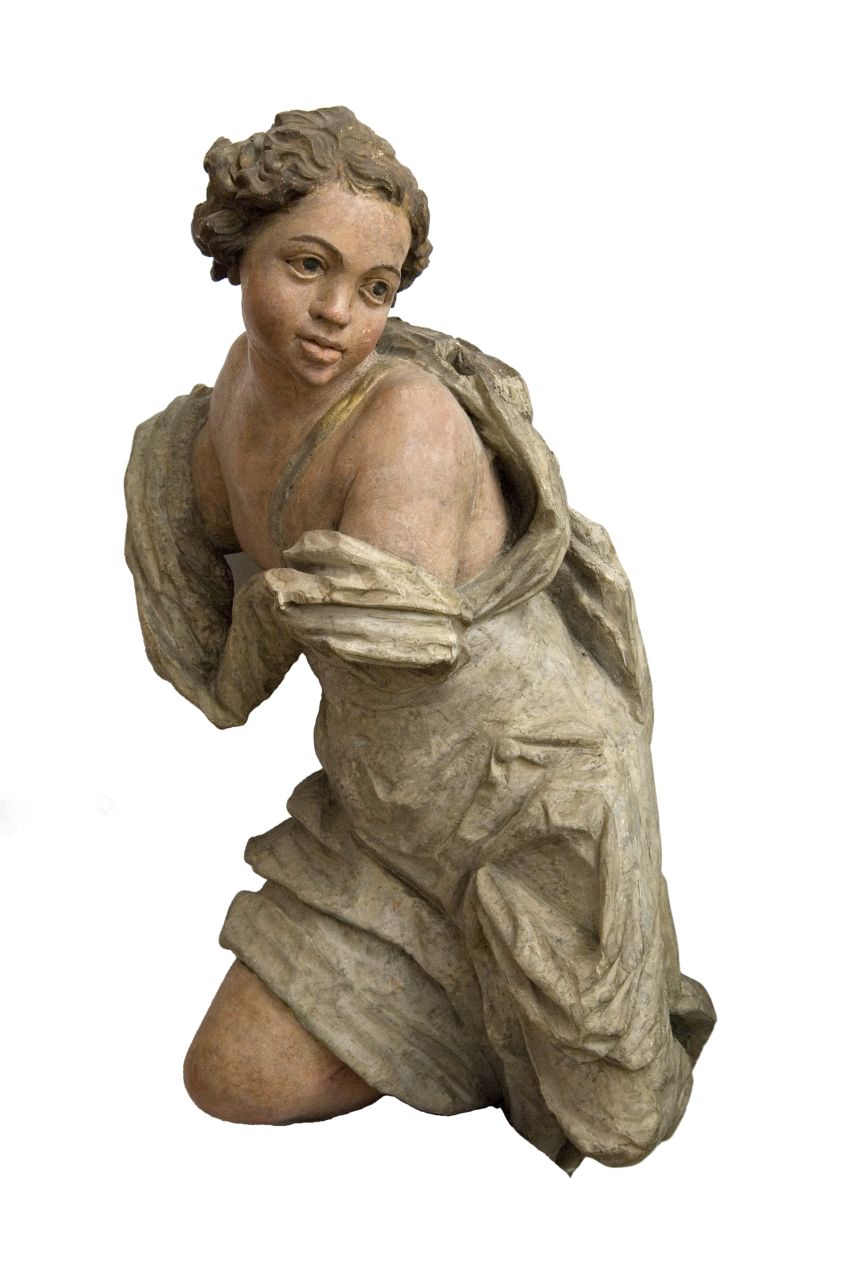
Thomas Hutter, sculpture Angel [MPS-4040, Credo exhibition]
Thomas Hutter was born in Bavaria in 1696 and died in 1745. The sculptor came to Poland in 1718. In the following years, he completed commissions for churches and palaces in the Małopolska region. His works were appreciated, and his style became increasingly recognizable. He completed sculptural commissions for parishes in Sandomierz, Tarnów, Rzeszów, Leżajsk, Przemyśl (1724-1733), and Lviv, among others. In 1736, the artist and his wife, Anna (née Kowalska), settled in Jarosław. There, he opened a sculpting workshop located in the Orsetti Tenement House – currently the seat of the National Museum in Jarosław. The angel, from the collection of the National Museum of the Przemyśl Region, likely comes from the interior design of Przemyśl Cathedral from the early 1730s. In the following century, this interior design was replaced by the current neo-Gothic furnishings. The angel is likely the only surviving sculpture. The sculpture is made of linden wood, covered with polychrome and gilding. In a late Baroque style, it depicts an angel from a glorifying group. The angel has boyish facial features, shown kneeling. Unfortunately, his wings and arms have not survived. The sculpture displays characteristic features of Hutter’s style, such as a physiognomy with coarser features, large and expressive eyes, a fleshy mouth, the carving of the hair, and the arrangement of the fabric folds.