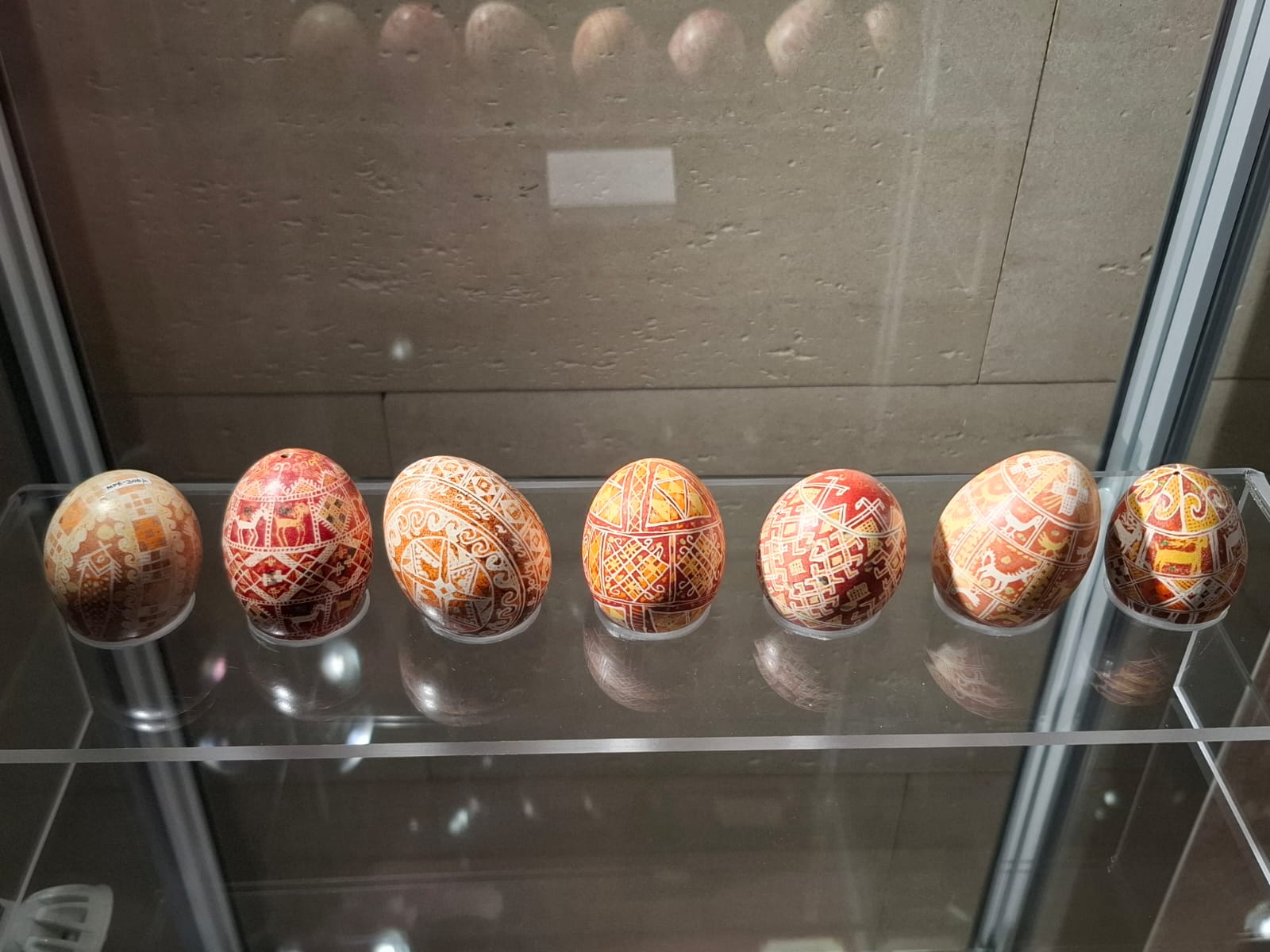
All the Easter eggs presented in the exhibition come from the Hutsul region. They were made in 1936. They are part of the collection of the National Museum of the Przemyśl Region. Hutsul Easter eggs are made using the batik technique, which involves applying hot wax to an egg and dyeing it in successive colors. This technique requires training, which is why Hutsul girls began carving Easter eggs very early, mastering them over many years. The most beautiful, intricate, and refined Easter eggs were considered amulets and holiday gifts for relatives and friends. They are crafted with incredible precision and care. Hutsul Easter eggs are distinguished by their rich ornamentation and extremely fine patterns, which can be described as mosaic-like. Geometric motifs dominate, including lines, triangles, circles, rhombuses, rectangles, curls, crosses, grids, spirals, and checkerboards, which carry solar, magical, and fertility symbolism. Zoomorphic ornamentation is also characteristic of Easter eggs from the Hutsul region. Images of horses, deer, birds, and fish are among the decorative motifs that serve ancient magical functions and enhance the egg’s power. The “tree of life,” a symbol of infinity and the connection between life on earth and eternity, often appears on Easter eggs. Various ornaments fill the entire surface of the egg, most often in a striped arrangement. The background colors of Hutsul Easter eggs are yellowish-brown or black, while decorative motifs in yellow, orange, red, green, and white fill the entire surface of the egg. Warm colors are characteristic of Hutsul Easter eggs.
Easter eggs