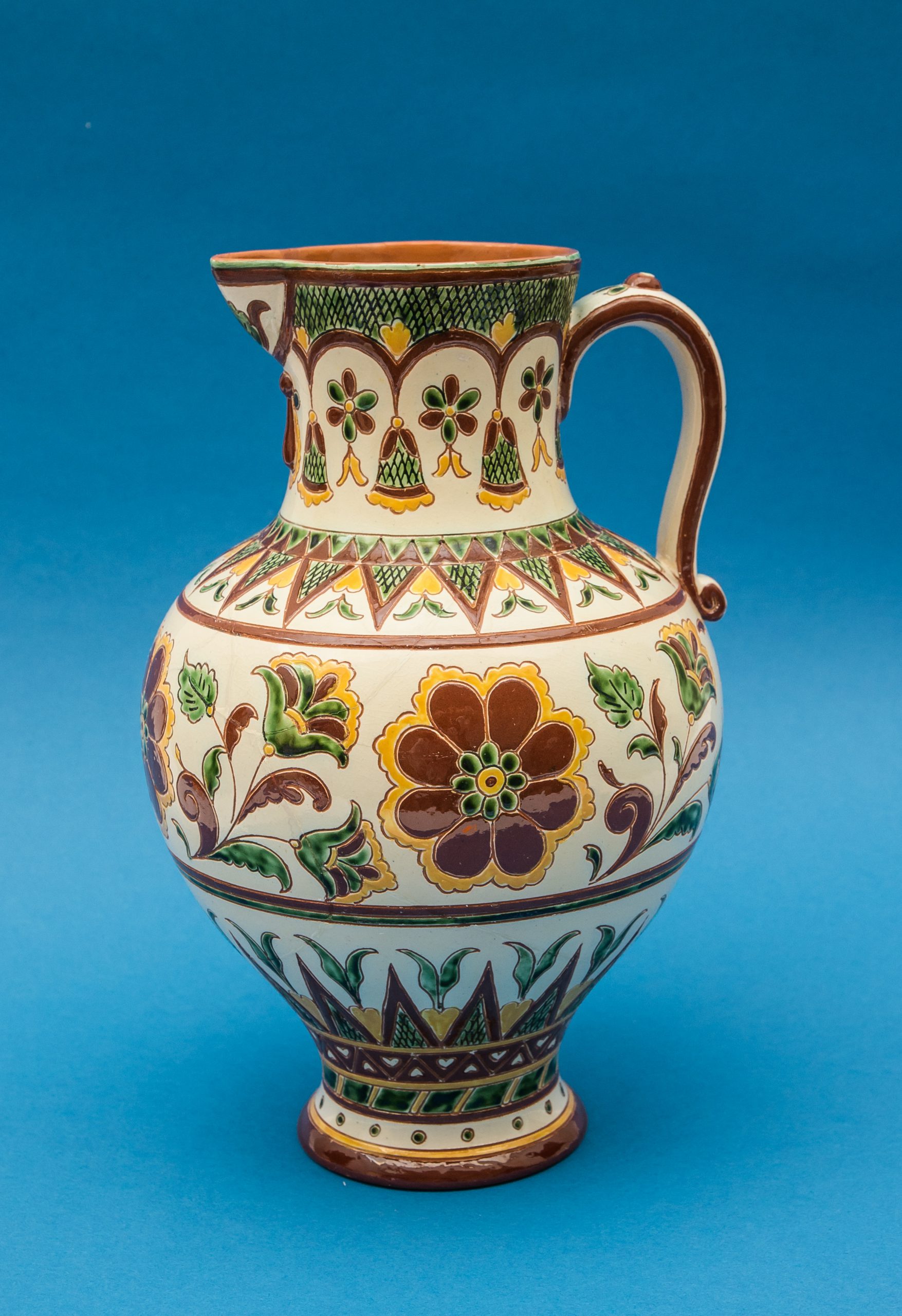
A 30 cm high clay jug. Probably made by Aleksander Bachmiński from Kosiv. It was probably made in the late 19th century. In the collection of the National Museum of the Przemyśl Region. The jug is a piece of prized and sought-after Pokut pottery. Hutsul pottery is commonly called Pokut, after its production location – the Pokut region in the eastern Carpathians. The main ceramic centers included Kuty, Pistyń, Kolomyia, and Kosiv. The jug is white and decorated throughout with flowers and geometric figures in a horizontal stripe pattern. It consists of a round base, a bulging body, and a neck with a spout. It was made according to the technological process of Hutsul potters, i.e., after appropriately preparing the ferrous clay, the vessel was formed on a potter’s wheel. After drying, a layer of engobe imitating faience was applied. Once the base hardened, the decorative motif was engraved. It was painted in several colors typical of Hutsul pottery: yellow, brown, and green. Finally, a lead glaze was applied, and the jug was fired. The jug is an everyday item for storing and serving various liquids, but also decorative. The surface of the body features a regular floral motif: eight-petaled brown, yellow, and green flowers and cup-shaped flowers with brown and green leaves, with a thin brown line running along the top and bottom of this ornament. Attached to the body is a neck richly decorated with regularly repeated six-petaled flowers and bell-shaped flowers topped with brown arcs at the top. Below the neck is a band of brown and green serrated edges and triangles. A handle is attached halfway along the body and below the spout. A spout is modeled on the rim of the spout. The surface under the spout is green with a fine grid pattern. The base of the jug is decorated with geometric and floral patterns. The diameter of the spout is similar to the diameter of the base.
Jug (Hutsul pottery)