

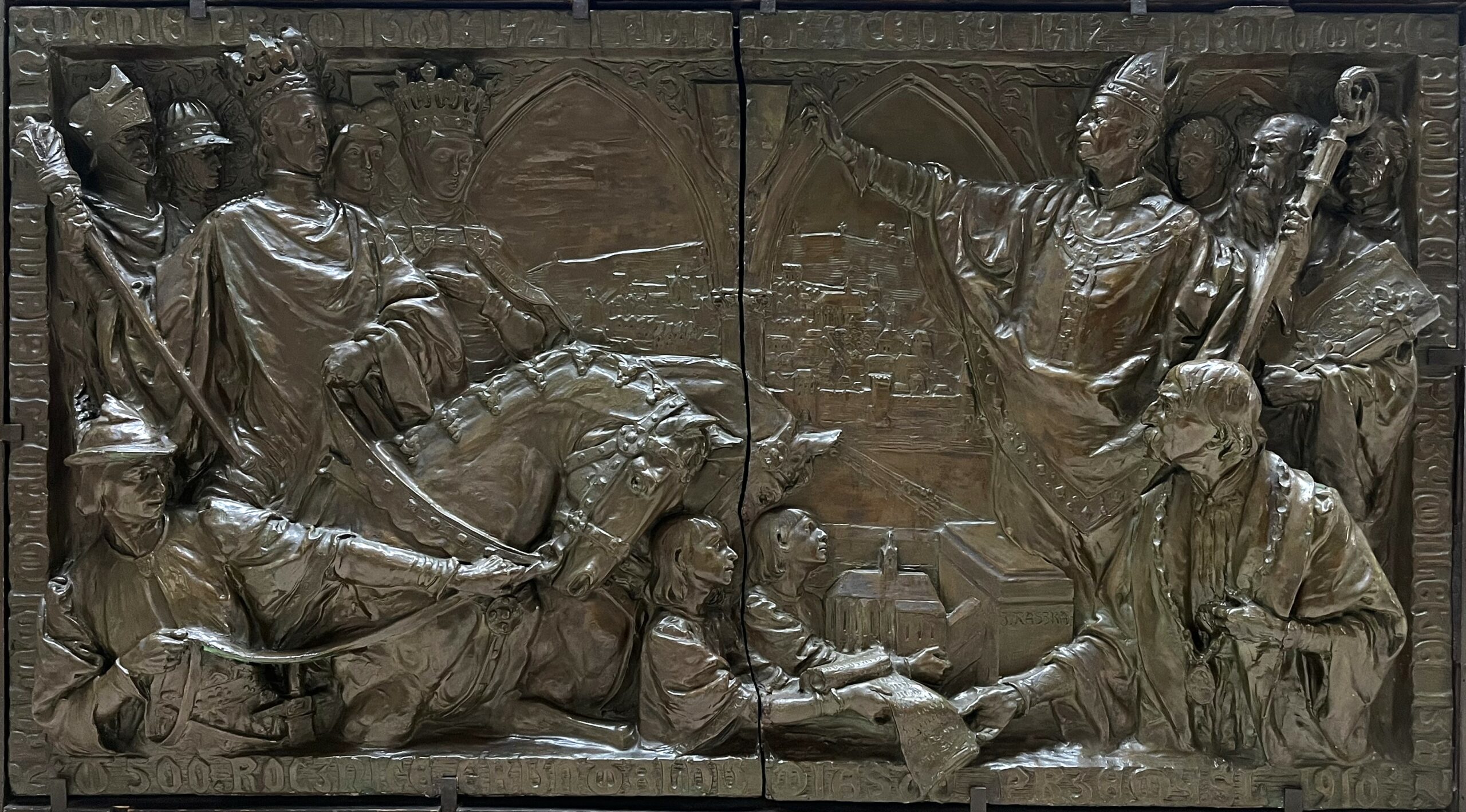
Design of the Grunwald Plaque. [ZNr-5498, main hall of the building]
A 1:1 scale plaster model of the Grunwald Plaque, by Jan Raszka of Kraków (1871-1945). In 1910, the plaque commissioned from the artist was intended to honor the celebrations of the 500th anniversary of King Władysław Jagiełło’s victorious battle against the Teutonic Order. Such celebrations and demonstrations of patriotism were only possible in the Galician autonomous region. The plaque also serves as a testament to the unity of the Przemyśl community, which, despite a lack of funding from the city authorities, launched a fundraising campaign that made its creation possible. The original plaque, cast in bronze, is located on the exterior wall of the cathedral’s chancel. Its ceremonial unveiling took place on October 29, 1910, and the official consecration was performed by the Bishop of Przemyśl, Józef Sebastian Pelczar. The scene depicted on the plaque does not directly refer to the Battle of Grunwald, but is a tribute to King Jagiełło for the privileges and rights granted to the Przemyśl town. The artist’s concept depicted the royal couple being welcomed by the city and church authorities of the time. Two young squires precede the procession, carrying the king’s “gifts” to the city: the royal charter granting the charter and a model of the newly founded cathedral. The figures are depicted against the backdrop of Gothic arcades adorned with the Przemyśl coat of arms, with the city skyline visible in the distance. The artist faithfully depicted the figures. The portrait of Jagiełło and Jadwiga is based on their tombstone sculptures at Wawel. The models for the remaining figures were contemporary figures from Przemyśl. The artist portrayed Bishop Winsen as Bishop Pelczar, the first mayor Michał as Mayor Franciszek Doliński, and the townspeople – members of the board of the Society of Friends of Science, including Father Dr. Stefan Momidłowski and attorney Dr. Józef Scheinbach. Among the royal entourage is a self-portrait of Jan Raszka and a portrait of the architect Kazimierz Osiński.