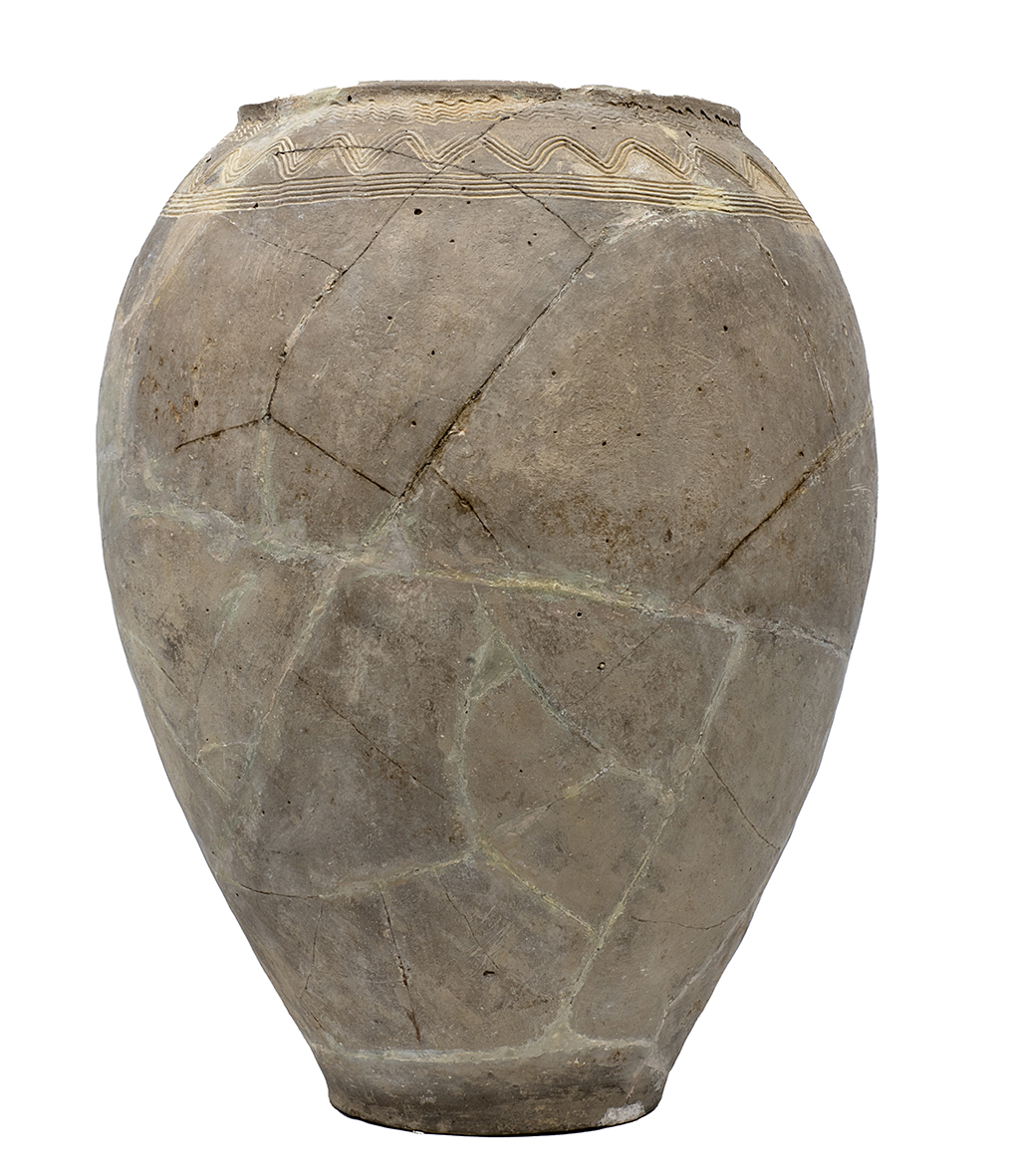
A clay storage vessel from Przedzielnica, Ukraine. Dimensions: height 58 cm, rim diameter: 28.5 cm, body diameter 43 cm, bottom diameter 17 cm. Dated to the late Roman period: 3rd-5th centuries AD, Przeworsk culture. A large vessel with a bulging body and a very wide, upturned rim, as well as a rim with grooves and rollers. The upper part of the vessel is decorated with a multi-row arrangement all around. Just below the short neck, five parallel, wavy lines are carved with a multi-toothed tool, creating a pattern of small mounds. Below these, a decoration in the form of large waves is created using the same tool. The decorative motif is finished with five horizontal grooves carved below. The gray color of the vessel’s surface indicates firing in a pottery kiln in a reducing atmosphere with limited oxygen. These thick-walled, large-sized vessels with bulbous bellies were intended for the permanent storage of food supplies, such as cereal grains, as well as other agricultural products or their processed products. They were used on farms and in food-producing areas. Due to their characteristically shaped rim, they are referred to as so-called “reserve vessels with a flanged rim” (Krausengefäße) or “wide-flanged” vessels. To protect the contents, the opening of the vessel was covered with a wooden, stone, leather, or textile cover. The flanged rim likely served to tightly seal the vessel. This type of pottery appeared in the Przeworsk culture under the influence of impulses flowing from the south and southeast, from the Dacian cultures, which in turn were influenced by La Tène and provincial Roman environments. They resemble Roman large-scale storage vessels called dolium, which, in addition to grain, were used to store wine, grape skins, and olive oil. Significant quantities of dolium were often stored in a single location under a roof or buried halfway underground. Storage vessels became popular in Central Europe during the Late Roman Period and the early phase of the Migration Period, although they had appeared earlier. Due to the lack of precise data on the circumstances of the discovery of the Przedzielnica artifact, we can only assume that the vessel originated in a settlement and was likely used to store food materials.
A storage vessel from Przedzielnica