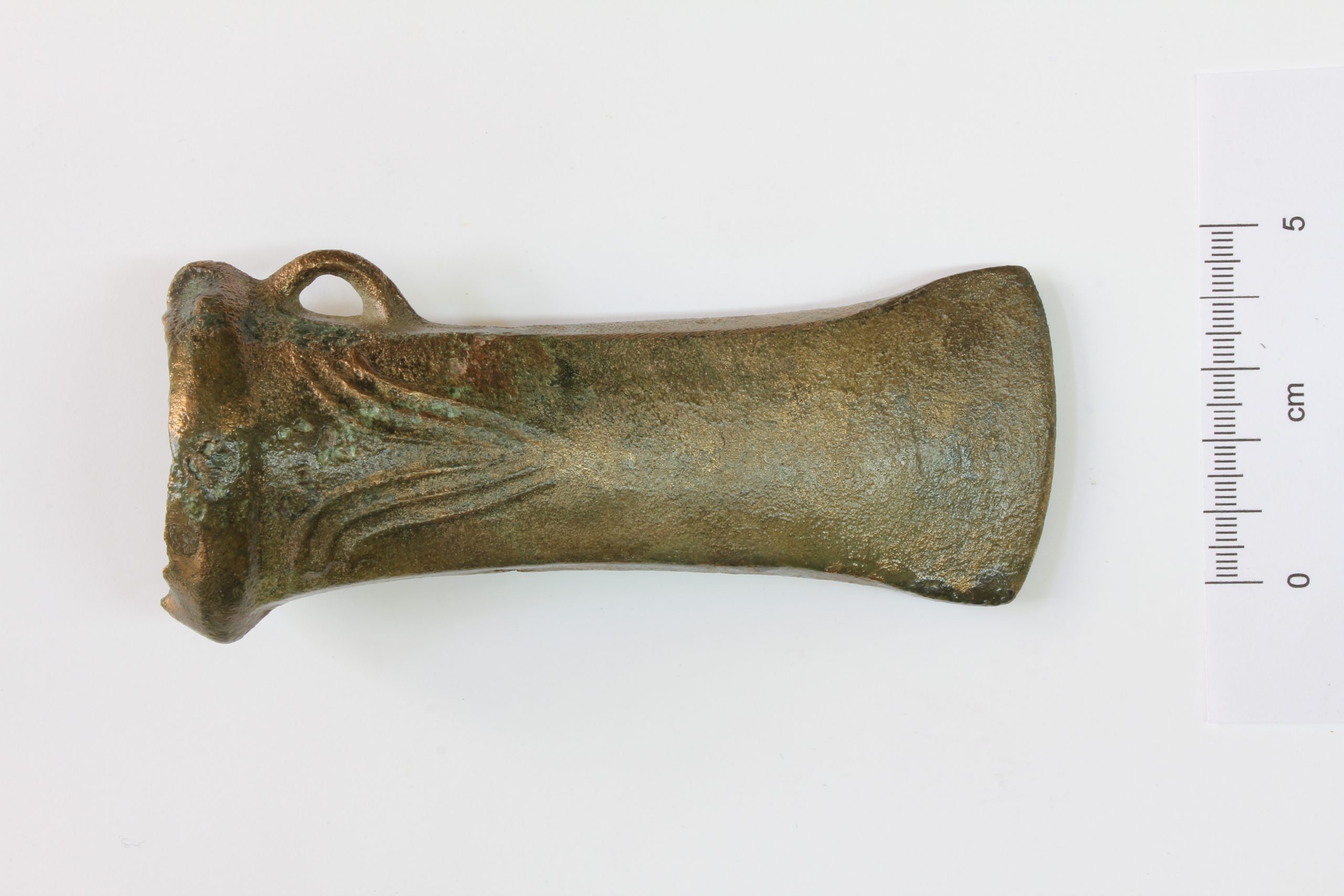
This bronze axe comes from the museum’s former collection. Information on its location and circumstances is unknown. The item can be classified as a “Central European axe with a straight-ended socket.” Unlike other examples of this type, it has a slightly different decoration of interlocking triple triangles. Their tips are rounded, pointing towards the blade. The tips of other axes are sharp. Such axes are most likely associated with local production based on Transcarpathian forms. A few similar examples come from Slovakia. The axe measures 12 x 4.7 x 3.7 cm and weighs 300 g. It is cast in bronze. The axe can be dated to between 1200 and 1100 BC. Defining the precise function of axes in the prehistoric period is not easy. They could have served both as tools and weapons, or as a marker of the owner’s social status. Axes may have served as pre-monetary currency, as suggested by the standardized shape and similar weight of each type. Nevertheless, they are primarily considered objects used for woodworking. They are less frequently attributed a weapon function. Objects of this type were cast in specially prepared clay or stone molds. Axes with a socket and a handle are among the youngest types of bronze axes. Those equipped with a socket allowed for the attachment of a handle, which was a specially prepared stick. A small eyelet served to connect the axe to a wooden handle. A rope or strap was threaded through the eyelet and then wrapped tightly around the shaft or near the edge of the socket. A significant portion of these finds are from Transcarpathia. They are mostly concentrated in southern Poland, including in the areas covered by the settlement of the Tarnobrzeg Lusatian culture.
Bronze Axe