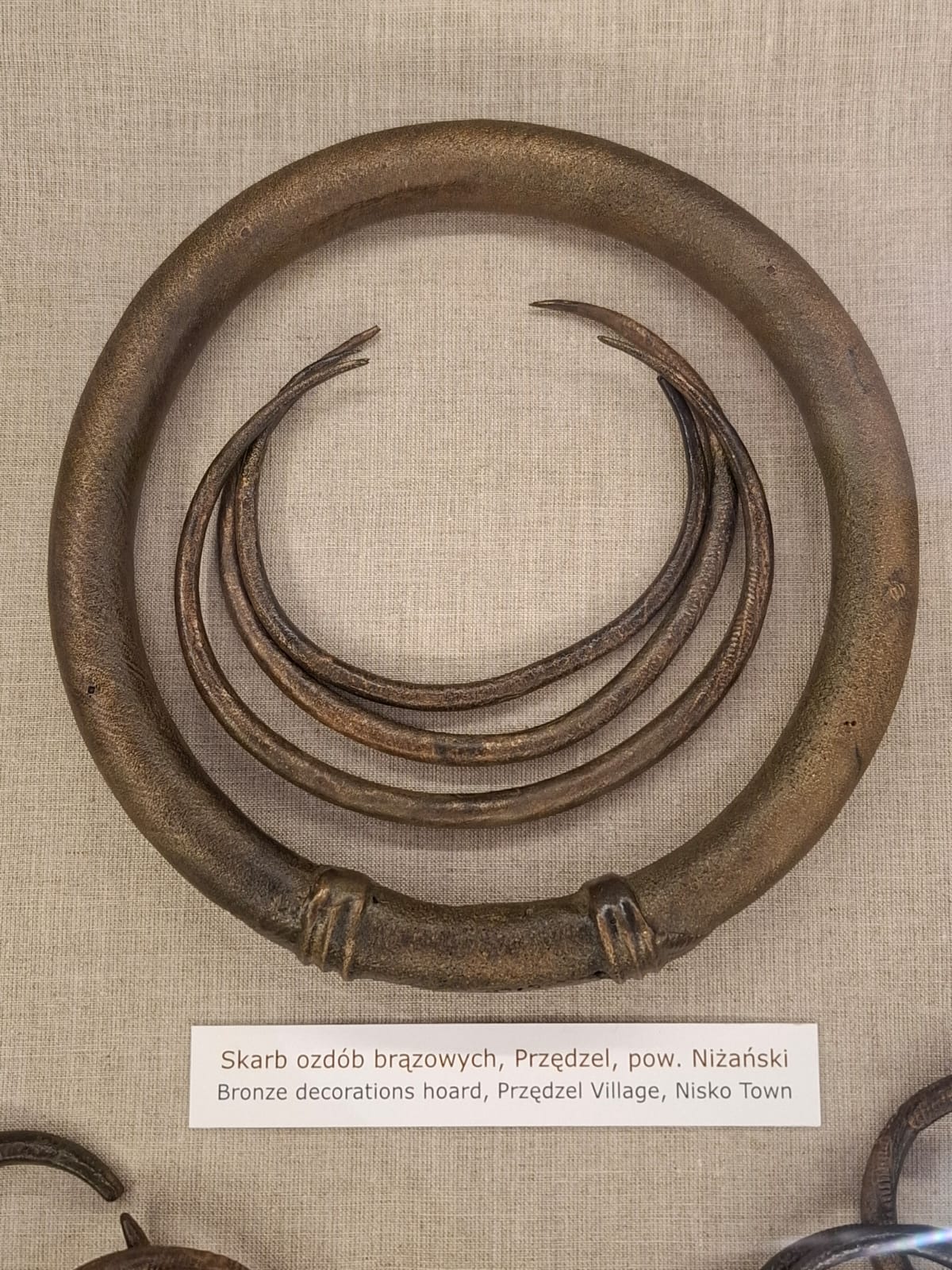
The presented hoard was discovered in the early 20th century in the village of Przędzel, Rudnik commune, in the Podkarpackie Voivodeship. Details regarding the location and circumstances of its discovery are unknown. The hoard dates to the Middle Bronze Age and is believed to date from 1200-1100 BCE. The necklaces range in size from 13.5 to 16.8 cm in diameter and 0.8-1 cm in thickness. The bracelets range in diameter from 7.6 to 8.4 cm and are 1.5 to 1 cm thick. The most impressive closed necklace measures approximately 25 cm in diameter and is 2.4 cm thick. The term “hoard” refers to a find discovered in a group, consisting of a group of valuable objects deliberately placed in one place. Their deposition may have been for various reasons, including economic, political, cultic, and sociological ones. The Przędzel hoard is classified as part of the so-called “Sieniawa horizon.” It is a group of finds dated within a narrow timeframe, occurring in southeastern Poland within the Tarnobrzeg Lusatian culture. The most characteristic finds of this group are massive closed necklaces, also known as large circles, known as the Sieniawa type. Also characteristic of this horizon are open necklaces with tapering ends and ornamented with bands of diagonally running lines alternating with a herringbone motif, as well as similarly decorated bracelets with overlapping ends. Due to the lack of faithful analogies in other areas, these can be described as a local form. The regional distribution suggests the possibility of a metallurgical center specializing in the production of this type of jewelry by the people of the Tarnobrzeg Lusatian culture. The Przędzel assemblage consists of ten artifacts. All of them are hoop jewelry: three open necklaces, six bracelets, and a closed necklace. The pieces are decorated. Unfortunately, their surfaces are heavily damaged, making the ornamentation very difficult to see. The decorations likely served a utilitarian purpose. Together, they create a unique set of ornaments. The closed necklace was made by casting on a clay core. Both the necklaces and bracelets were cast in decaying molds using the lost-wax technique.
Bronze Ornament Hoard from Przędzel