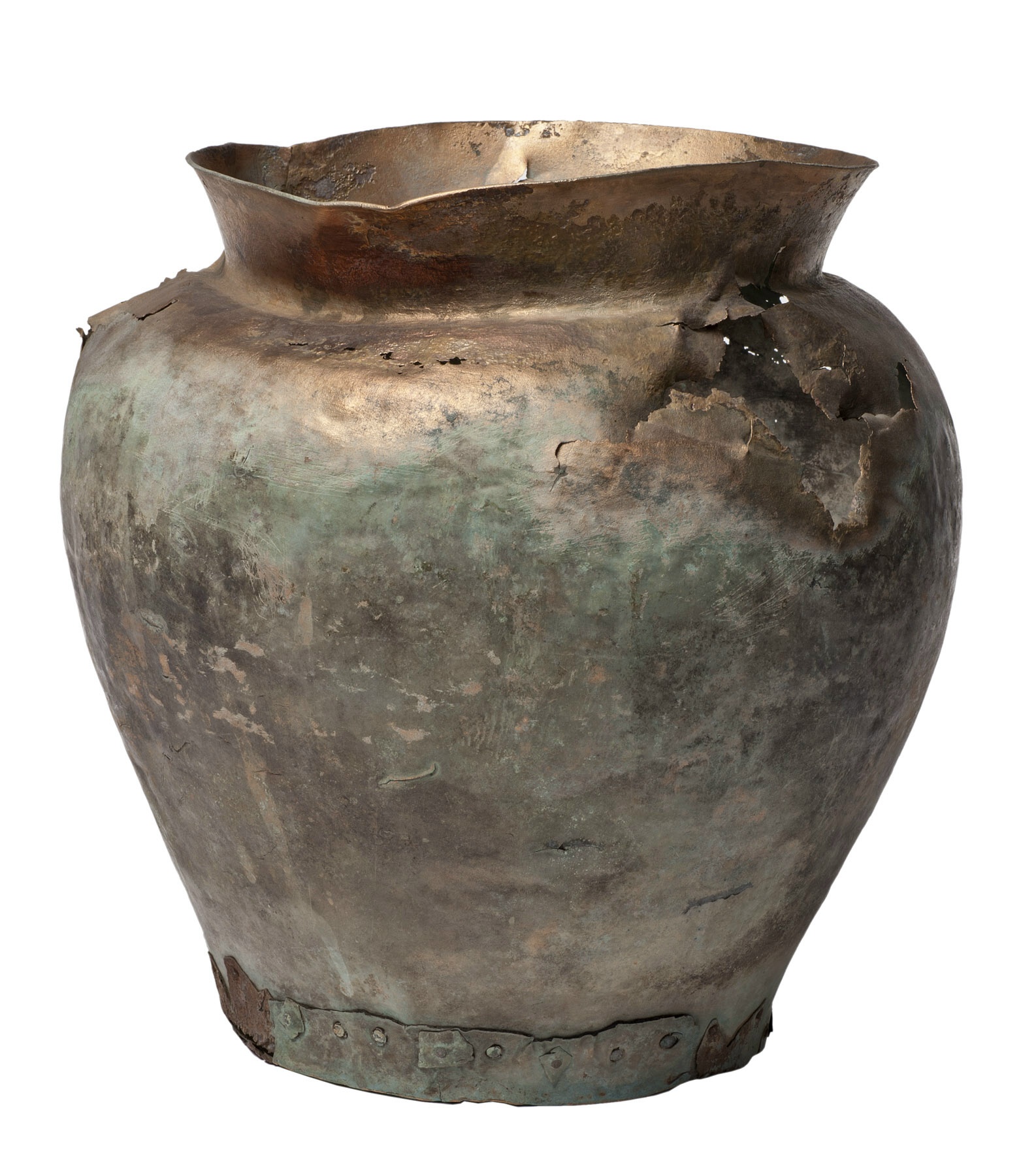
A bronze situla found in 1939 in the Kazanów district of Przemyśl during salvage excavations conducted by Kazimierz Maria Osiński. The situla’s height is approximately 32.5 cm. The body at its greatest bulge has a diameter of approximately 31.9 cm, the rim approximately 24.2 cm, and the base 19.5 cm. The Przemyśl situla is a bucket-type vessel forged from bronze sheet metal that has been repeatedly repaired. The vessel lacks a handle, or attachments for a bow. Nor does it have a preserved iron hoop that would have allowed it to be carried. The artifact has an asymmetrical shape and a very irregular profile due to its handcrafted nature. Deformations could also have occurred during the vessel’s use or as a result of post-depositional processes, so the given diameter dimensions are somewhat approximate. The upper part of the body is slightly damaged in several places. Numerous repair patches and rivets, made at different times by craftsmen with different technological traditions, are visible at the bottom. Situlas were produced in Italy, Central, and Southeastern Europe from the Late Bronze Age. The vessels served a utilitarian function as buckets for drawing and carrying water, or a ritual-magical function during religious ceremonies. They were also reused for funerary purposes as urns in which the cremated bones of the deceased were deposited. In the case of the situla from Przemyśl, no information about its contents has survived, so its funerary function is uncertain. The Przemyśl artifact was originally identified as a Roman import, and its date has been established to the early or late Roman period, from the 1st to the 4th century AD. However, recent research indicates that the vessel may have been made in a workshop with Celtic traditions, modeled on Italian situlas. This theory is supported by the manufacturing technique used, i.e., hand-forging, and certain repair methods, such as the use of rivets from rolled sheet metal. The absence of attachés does not rule out the use of another, unpreserved type of fastening. The iron hoops placed on the vessels, which allowed for better weight distribution, could be unriveted and removed without leaving any trace, and the technique of joining bronze and iron elements is considered typical of Celtic craftsmanship. It is therefore possible that the situla reached the Przemyśl area as early as the early pre-Roman period, around the 1st century BC.
Bronze Situla from Przemyśl-Kazanów