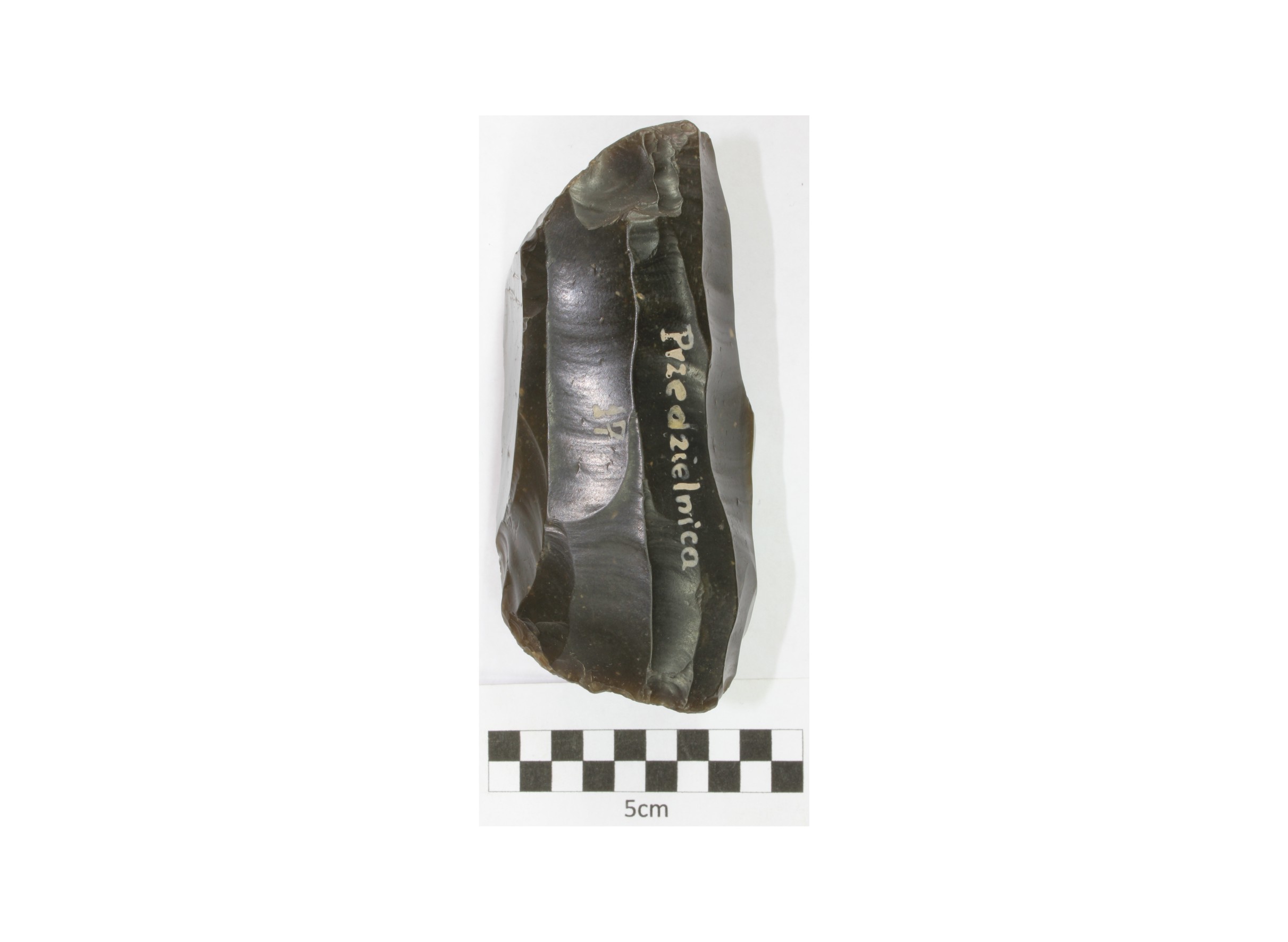
A flint core was found near the village of Przedzielnica, now located in Ukraine. This artifact was made by representatives of the Late Paleolithic Swiderian culture and dates to the 9th-8th millennium BCE. Dimensions: maximum length 8.4 cm, maximum width 3.8 cm, and maximum thickness 4 cm. From the front, it has the shape of a rather slender, irregular oval, while in the side view it is trapezoidal. The front surface of the specimen is almost entirely covered with traces of negatives of the chips deflected from it. The negatives are conchoidal, elongated, with clearly perceptible raised edges and a smooth, slightly glassy texture. Within them, slight depressions and elevations can be felt, created by the passage of a shock wave within the silica mass during the deflection of successive half-serous fragments. Additionally, negatives from small technical flakes, intended to prepare the core for exploitation, are present at the top and bottom. A small fragment of one of the sides preserves the so-called cortex that originally covered the flint mass. The cortex surface is somewhat rougher to the touch, as it is composed of the limestone in which the flint mass was formed. The remaining sections of the sides bear traces of negatives from previously struck flakes that formed it. Here, too, are the tiny negatives of the technical flakes that shaped it. The top and bottom surfaces of the core were also deliberately shaped so that the edge between them and the front surface could provide a base for further impacts from above and below. The entire surface of the exhibit in question shows signs of quite intense smoothing of the edges between the negatives, which may suggest it has been exposed for a long time and exposed to wind and water. Flint cores are a very specific group of archaeological artifacts; they are human artifacts, but they are not typical tools. In the production chain, they constitute an intermediate form between raw material and the finished product. The exhibit in question comes from an advanced stage of exploitation, meaning that at least 20 blades—elongated flakes shaped like small knives—have already been separated from it. The sharp angle between the front and the upper and lower surfaces indicates that a skilled craftsman could have produced another 3-4 sets of blades from it. Therefore, this is not a production waste piece, but it is difficult to say why it was abandoned. Perhaps it was simply lost. The core in question has two striking edges, allowing the blanks to be separated from both the top and bottom. This type of production technology is known in prehistory primarily among the Late Paleolithic reindeer hunters of the Swiderian culture. The core is made of brownish-brown flint. The silica mass is slightly transparent. Small, lighter dots are embedded within it, most likely the remains of limestone shells. Where a fragment of the cortex surface is preserved, the siliceous mass is noticeably lighter in color. The cortex itself is quite thin and smooth. Flints of this type occur in Volhynia and in limestone rocks in the Dniester Valley in Ukraine. This suggests that the artifact migrated from the northeast or east, along with people from a region approximately 200 km away.
Flint Core from Przedzielnica