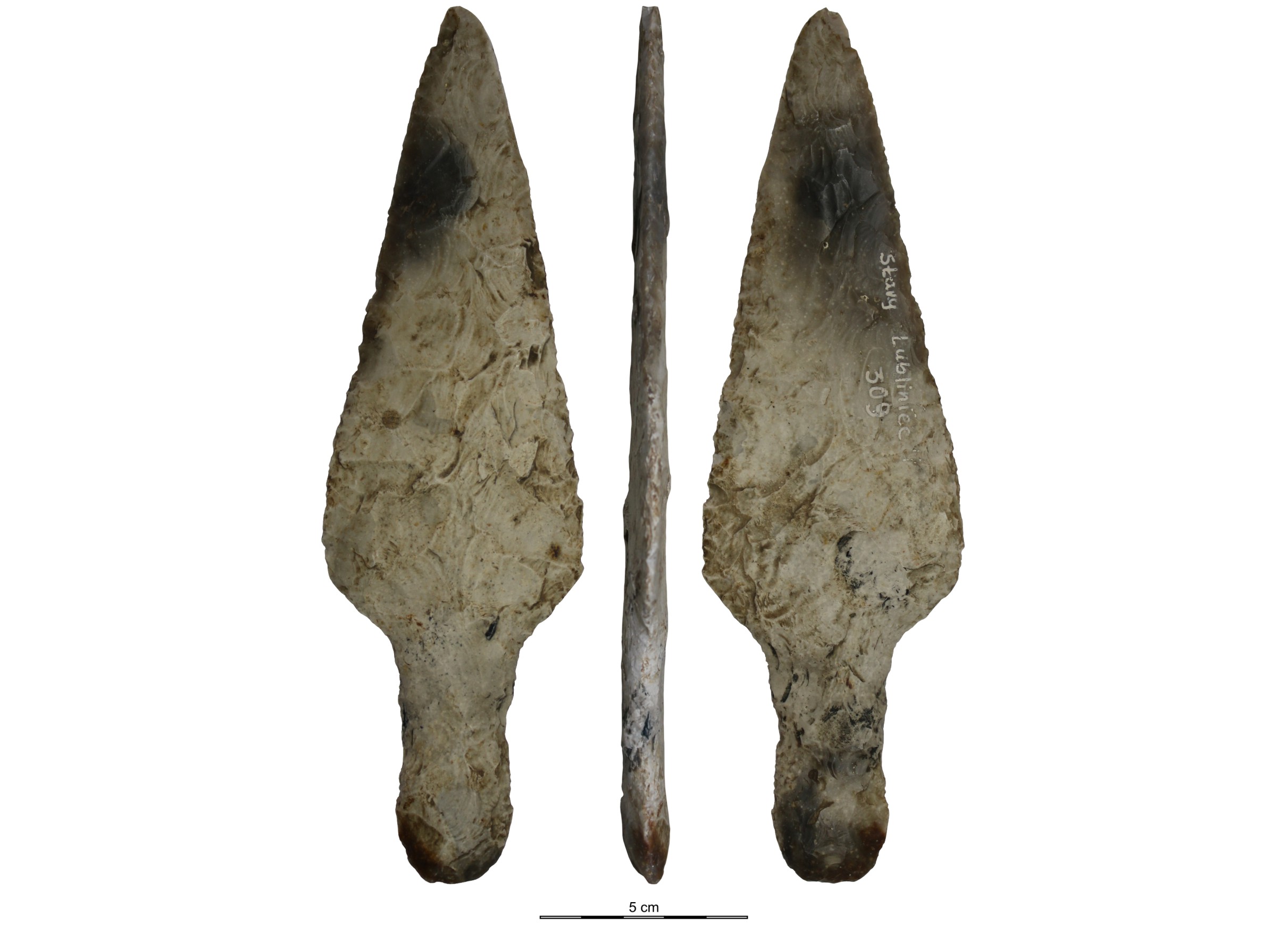
In the archaeological collection, a very large specimen of a flint blade—21 cm long, 6.2 cm wide, and 1.1 cm thick—found in Lubliniec Stary near Lubaczów is noteworthy. This artifact has a very regular, well-developed shape, attesting to the high craftsmanship of its maker. The blade is triangular, with straight sides converging towards the tip. The distinct base, in the form of a regular, oval-rounded handle, is slightly thicker than the blade section. In cross-section, the artifact has a lenticular shape, characteristic of all bifacial tools. A negative impact from a blow from the tip of the blade is visible on one of the lateral edges, eliminating part of the cutting edge. Such damage could have occurred when striking a hard surface if it was used for throwing—as a spearhead—or as a thrusting object if it was mounted in a handle and used as a knife. This artifact was made using the core method, by striking off a series of flakes from the sides on the front and rear surfaces, designed to form the functional part of the tool from the remaining flint mass. Remnants of the aforementioned process are visible in the form of numerous negatives with fan-shaped shapes and distinct waves of reflections radiating from the impact points. Negatives from the impact of small flakes that formed the final shape of the specimen are preserved on the lateral edges. Similar, but more numerous, traces of the shaping flakes are found on the lateral edges of the handle. Analysis of the exhibit’s form—classifying it as a spear with a well-defined handle and a triangular blade—despite the find lacking a broader archaeological context, based on analogies to finds from other archaeological sites, can be fairly confidently dated to the Early Bronze Age and linked to the communities of the Mierzanowice culture. These items, in their shape, are already reminiscent of objects cast from a newly developed raw material—bronze. However, due to the limited availability of copper and tin in southeastern Poland, they will continue to be made from siliceous rocks for a long time to come. The spear from Lubliniec Stary is made of light-gray flint with small inclusions of darker, slightly more transparent silica, within which numerous small whitish fragments of limestone shards are visible. This type of flint occurs naturally east of the upper Bug River and in the Dniester Valley, so it arrived in the Lubaczów area from present-day Ukraine in prehistoric times.
Flint shards from Lubliniec