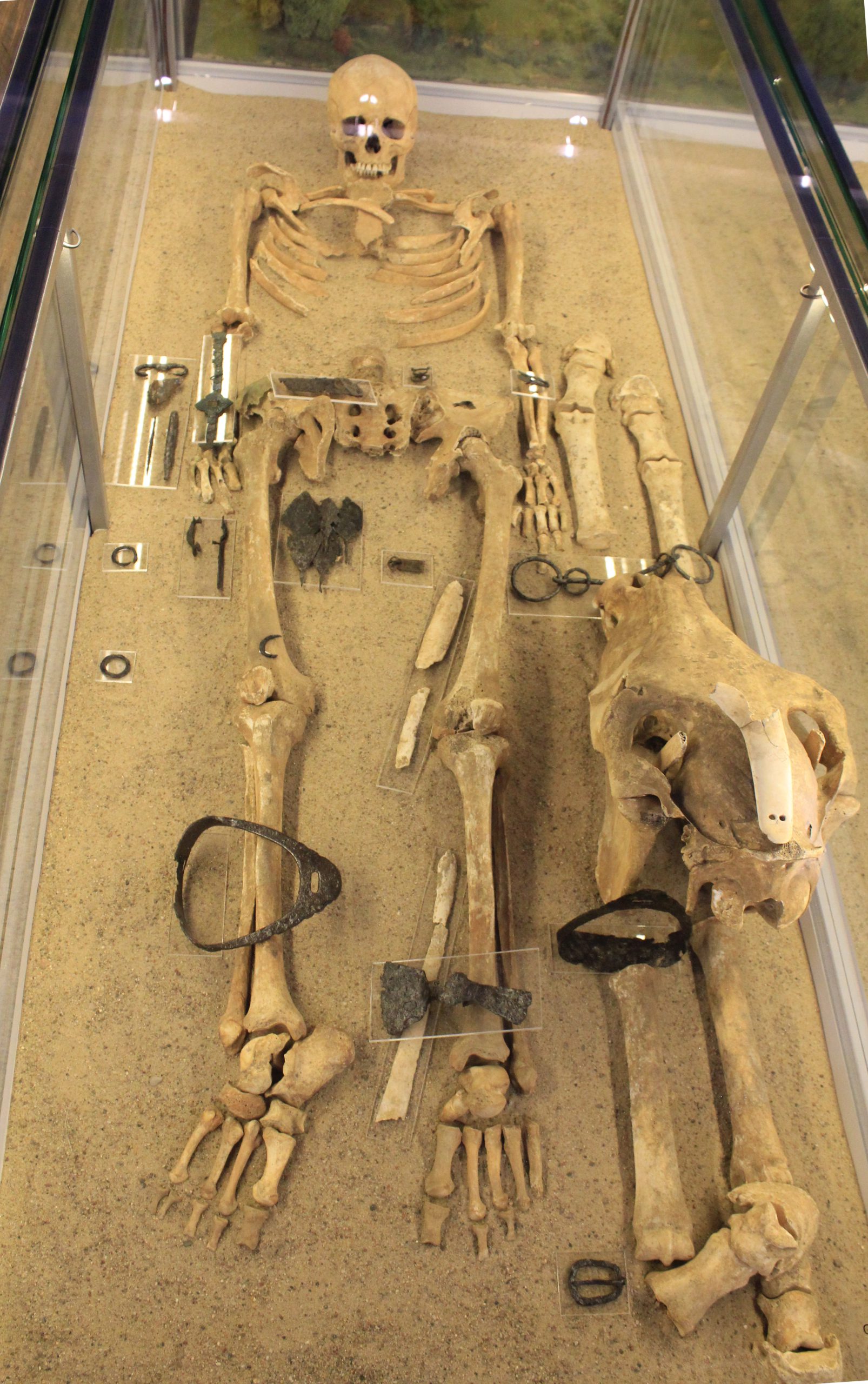
A male burial with the remains of a horse from an Old Magyar cemetery. Found in Przemyśl’s Zasanie district and dated to the late 9th – first half of the 10th century. In 1976, the first Old Magyar burial was discovered on a plot of land on what was then Rycerska Street (today Gen. M. Karaszewicza-Tokarzewskiego Street). Excavations were conducted at this site between 1977 and 1982, uncovering a total of 16 graves. The cemetery was located on the eastern edge of a promontory, a branch of one of the hills rising on the left bank of the San River. Among the burials, grave no. 6 stood out for its wealth of inventory. A rectangular structure with a rounded eastern side and dimensions of 285 x 80-95 cm, it was oriented southwest-northeast, with a tilt to the east. The grave contained the remains of a man buried in an upright position, with his arms at his sides and his head facing west. On the deceased’s left side, near his legs, were the skull and limbs of a horse, as well as three cattle ribs. During the grave’s exploration, numerous items representing the equipment of a mounted warrior were discovered, including elements of riding equipment (an iron bit, two stirrups, a rectangular girth buckle) and weapons (iron quiver fittings and a bone recurve bow fitting, five iron arrowheads, an ice axe, and a saber pendent fitting). Personal tools and clothing items were also found with the deceased: two decorative bronze buckles, a belt fitting, a rhomboid saddlebag fitting and its strap, a flint and flint stone, a chisel, and an iron awl. The double belt and richly decorated saddlebag indicate that the deceased held an important position, likely as a family chieftain. The necropolis is a row-based family cemetery and is unique in Poland. The grave goods and warrior burials, along with the remains of horses, indicate the Magyar origins of the deceased, providing direct evidence of the presence of Hungarian tribes north of the Carpathians. The nature of this stay is not entirely clear, but it cannot have been short-lived, since the cemetery contained graves of women and children in addition to male burials. It is possible that one of the watchtowers was located in the Przemyśl area, and the unit stationed there was tasked with defending access to the Carpathian passes.
Grave of an Old Hungarian warrior with a horse (exemplified by Grave 6 on Rycerska Street)