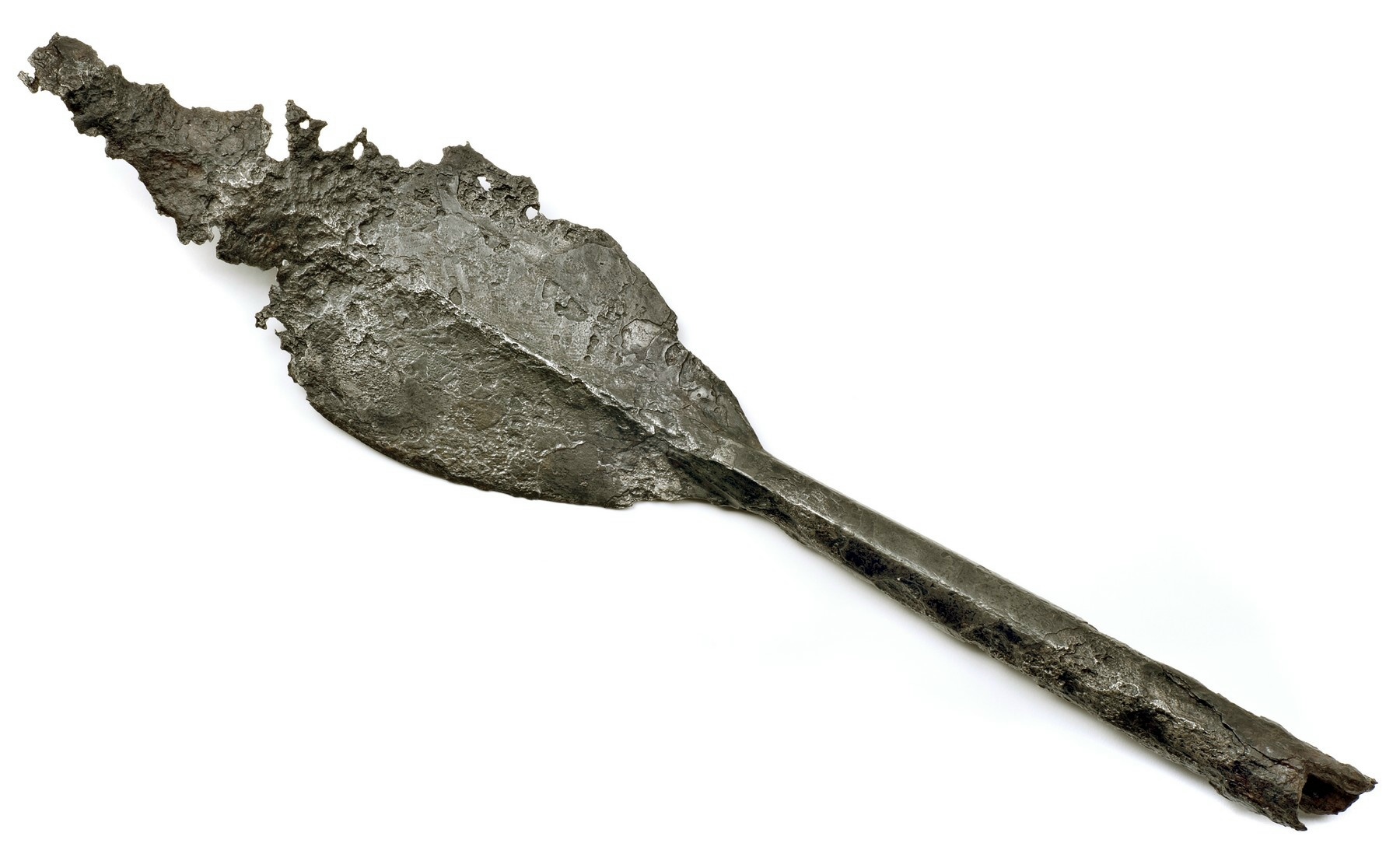
Iron spearhead from Pikulice near Przemyśl. Late 1st to early 3rd century AD. Przeworsk culture archaeological site, Roman period. The spearhead has a broad and relatively thin, arched blade with a clearly defined rib, with a total length of 37 cm. The tip and upper part show signs of corrosion damage. The octagonal socket, slightly widening towards the mouth, with a preserved rivet, measures 17 cm. The central surface of the spearhead blade is decorated on both sides with identical negative ornament in the form of stamped dots. In the central section, on both sides of the rib, run bands of punched dots forming curved lines. Another part of the decorative motif is formed by bilateral, arched bands composed of overlapping triangles, the inner fields of which are decorated with parallel dotted lines. The final, outer section of the ornament is formed by symmetrical, curved strips of successive triangles. These are alternately filled with or devoid of decoration in the form of punched dots. The upper part of the ornament was damaged by corrosion. The artifact was discovered in 1967 at the site of the old brickyard No. 12 in Pikulice near Przemyśl, at a depth of approximately 3 meters, as a single archaeological find. Over thirty spearheads with a similar ornament are known from Poland. The decoration in the form of so-called negative triangles can be interpreted as a symptom of the influence of the Wielbark (Gothic-Gepid) culture on the eastern zone of the Przeworsk culture. According to recent analyses, the geometric patterns with a vertical course may symbolize a pair of dragons or snakes (sometimes two-headed). The volute-shaped ends of the motif can be interpreted as their heads. Furthermore, the decoration in the form of negative triangles may resemble the mouths of mythical animals full of teeth or the characteristically decorated skin of snakes. Depictions of pairs of intertwining dragons were known in Celtic and Scandinavian culture. In the mythologies of many peoples, these legendary creatures were often depicted as great serpents and associated with the aquatic world. They also symbolized power, authority, and wisdom, strength, and prowess. On the other hand, they personified chaos, evil forces, and destruction. All these attributes fit well with the values of the warriors whose weapons they adorned. Yet another possible interpretation of the ornament is the depiction of a lightning bolt (on examples lacking the volute element). The decoration of the spearhead from Pikulice demonstrates a mixed type of ornamentation, in which a parquet pattern was applied to the rib, and then the object was adorned with a classical motif. Therefore, its chronology can be narrowed to the first half of the 2nd century AD.
Iron spearhead from Pikulice