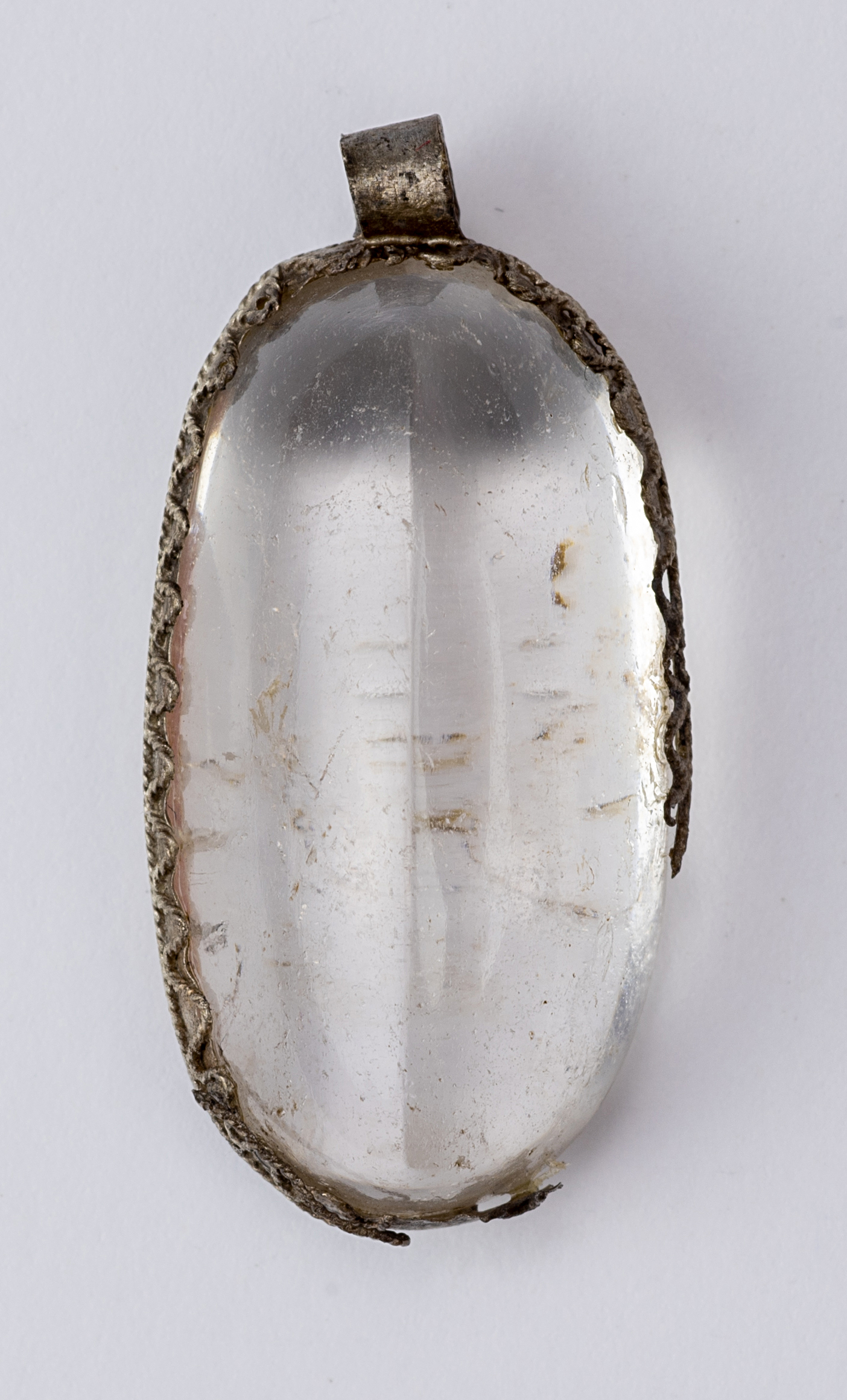
This rock crystal pendant is one of the most beautiful examples of early medieval jewelry in the Przemyśl museum collection. The oval, triangularly cut stone is set in a silver setting decorated with filigree. Two filigree wires encircle the ribbon-like frame, one running straight, the other zigzagging beyond its edge, creating a lace-like setting for the crystal bead. The pendant was found in a richly furnished grave discovered in the mound of a barrow in Sólca, Fredropol commune, Przemyśl County. It was part of the jewelry belonging to a young woman buried there, who died around the age of 18-20. In addition to the pendant presented, a second similar piece of jewelry was found with the deceased’s remains, along with four earrings, a ring, an ornamented bracelet, a small button, and a wire hoop. The earrings and pendants were found on either side of the skull. They were likely attached to a now-lost coif or headband that wrapped the deceased’s head. The archaeologist who discovered the jewelry in 1979 reported in his research journal that small fragments of tanned leather were also found with one of the earrings. In terms of the number and type of jewelry deposited, the graves discovered in the Sólca barrow are a rare find. In addition to the described assemblage, other graves also yielded items comprising a variety of exquisitely crafted jewelry. The range of jewelry deposited indicates that the individuals buried there were of high social and financial status. Analysis of the collections of ornaments found in individual graves allows us to date the burials discovered in Sólca to the 12th century to the first half of the 13th century. The silver wire rings, known as one-and-a-half coils, found within them, as well as silver-plated earrings with circular beads decorated with granulation and filigree, are typical ornaments of Ruthenian goldsmithing. However, finding a parallel to the pendant presented here is not easy. Certain formal associations arise when viewing pendants with lenticular crystal beads set in silver settings, dating from the 11th-12th century and found on Gotland. However, the Sólca ornament may have its origins among the richly ornamented jewelry created in the Byzantine Empire during the Middle Ages.
Rock Crystal Pendant from Sólca