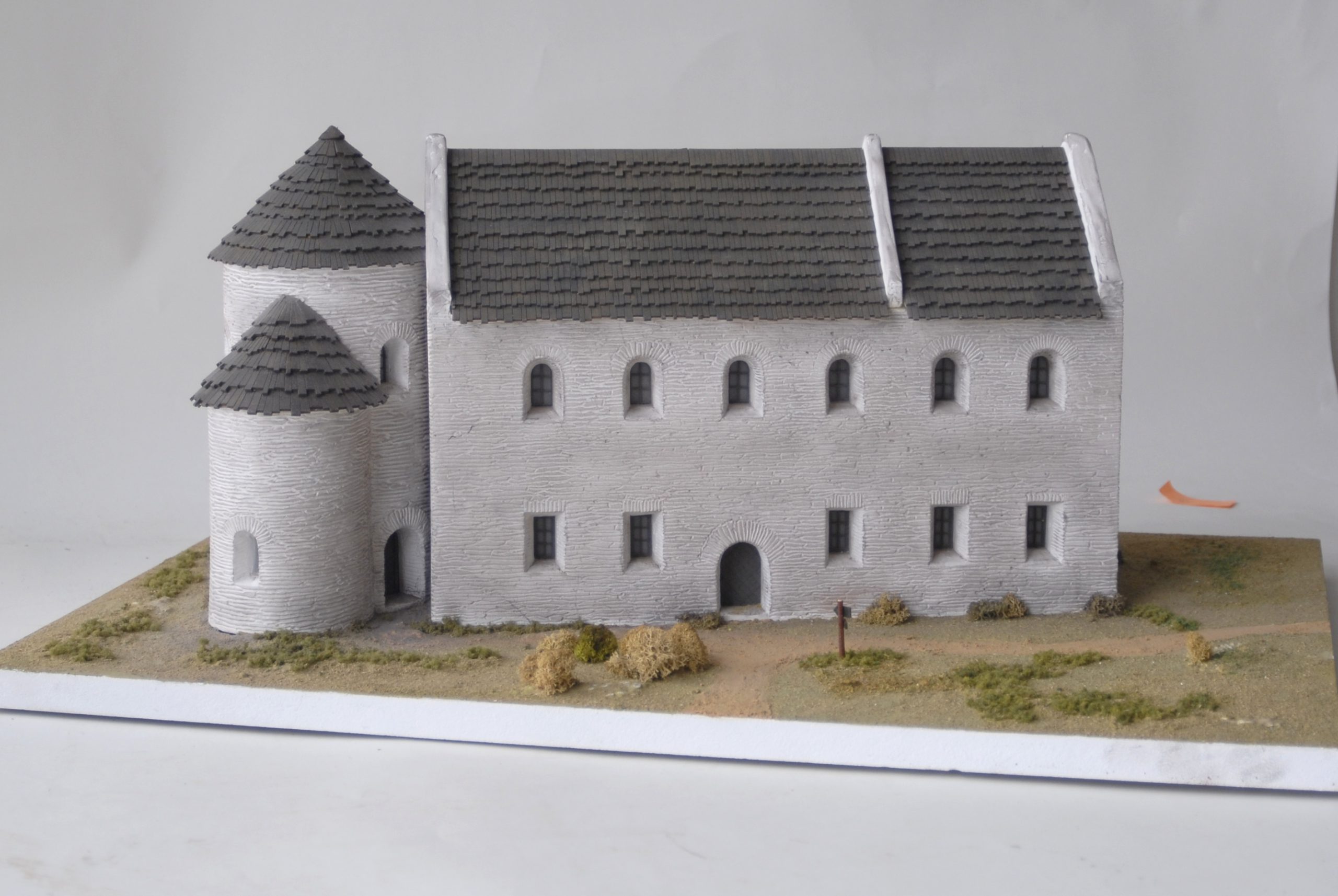
On Castle Hill in Przemyśl lie the remains of a palace complex with a rotunda. Their reconstruction is shown in a model presented at the exhibition. The plaster reconstruction was made in a 1:100 scale based on Professor Pianowski’s concept. The architectural complex consists of a rectangular residential building (palatium) measuring 33.6 x 15 m and a single-apse simple rotunda with an external diameter of 11.2 m and an internal diameter of 7.6 m. The horseshoe-shaped apse faces northeast and has an external diameter of 7.9 m and an internal diameter of 4.5 m. This design draws on the tradition of so-called great halls connected to a central structure with a gallery, and its construction is associated with the end of the reign of Bolesław the Brave and the reign of Mieszko II (1018-1031). The rotunda had four freestanding, circular supports with shafts 80 cm in diameter and trapezoidal wall pillars. These likely supported a second level of the room (a gallery or upper chapel directly connected to the palatium). The entrance to the interior of the temple was located on the north side. The structure likely served as both a palace chapel and a castle temple. Together with the representative/residential building, it formed a single architectural complex laid out on a northwest-southeast axis. The palatium building was once divided into several rooms: a palace hall with a series of stone pillars, a smaller room, and a so-called “corridor.” The walls were constructed using the opus emplectum technique from flat slabs of granular sandstone. The faces were made of stones cut into elongated slabs, creating a layered arrangement known as “petit appareil allongé.” The interior was filled with boulders, flat stones, and lumps of sandstone and conglomerate, poured with lime mortar containing sand, gravel, clay, and charcoal. Part of the rotunda beneath the northern entrance was constructed using the opus spicatum technique, while a section of the southwestern wall was constructed with boulders bound with clay. The palace complex, where the chapel is integrally connected to the palace building, harks back to the Piast complexes of Greater Poland. The Przemyśl architectural complex represents a transitional phase between similar complexes known from Ostrów Lednicki and Giecz and the Second Palatium in Kraków. It draws on Carolingian architecture and the monumental Ottonian and Salian architecture. The complex’s construction likely served to emphasize the dominance of the Polish dynasty in the newly annexed region. The architectural complex likely functioned for a short time and was demolished as early as the second half of the 11th century or the first half of the 12th century, or at the latest in the second half of the 13th century or the 14th century.
Rotunda-palatium complex