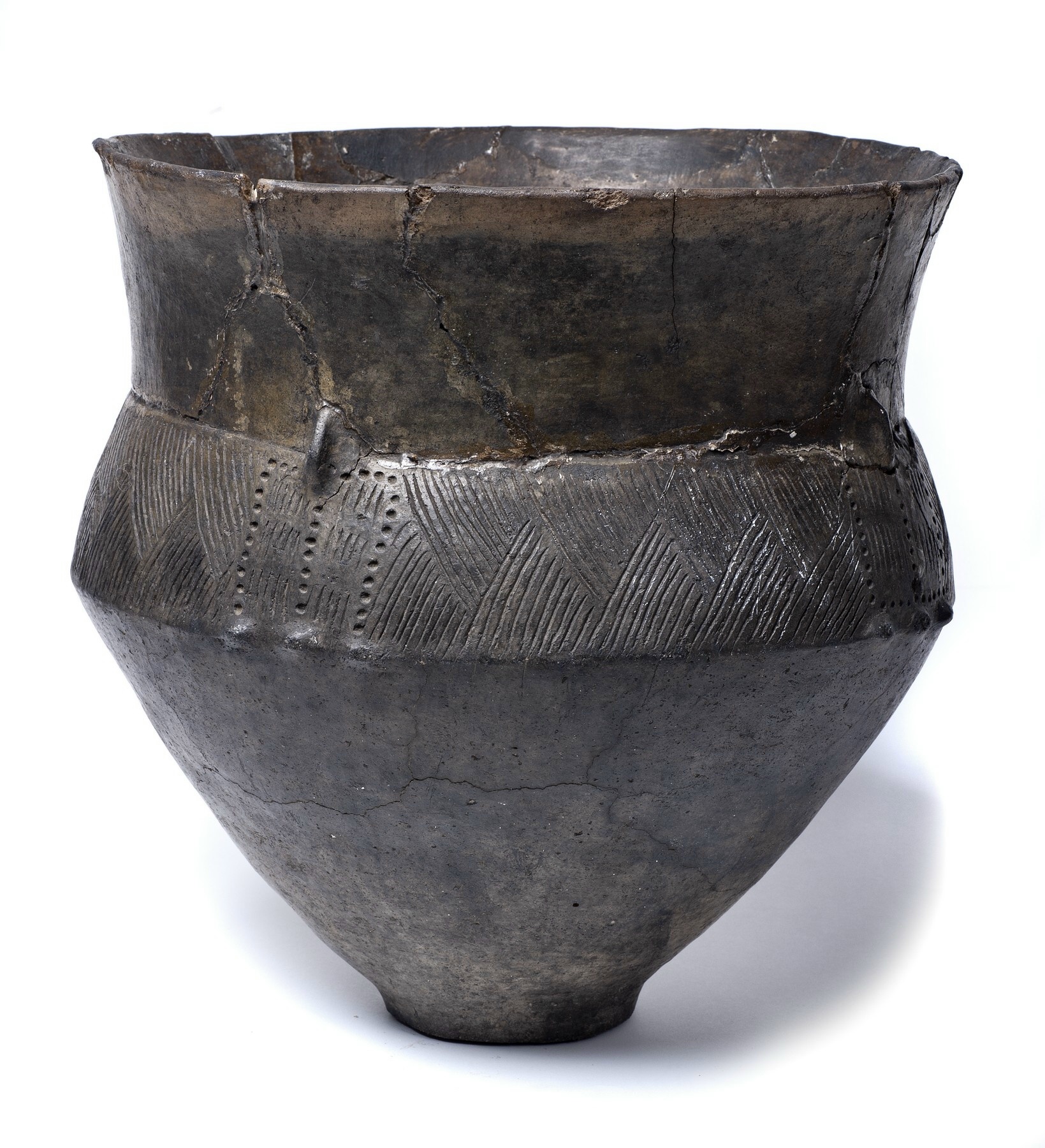
The three vases on display were discovered in the villages of Przędzel, Kopki, Rudnik nad Sanem commune, and an unspecified location. The vessels are meticulously crafted with original decoration typical of this type of artifact. They vary slightly in size and form. The dimensions of the individual vases vary only slightly. Their height ranges from 28.9 to 23.1 cm, the rim diameter from 28 to 20.7 cm, the belly diameter from 29 to 21.1 cm, and the bottom diameter from 9 to 7.1 cm. Dating from the 8th to 6th/5th centuries BC, one of the primary pottery products of the Tarnobrzeg Lusatian culture community is vessels made in the so-called San River style. This term encompasses a group of vessels (vases, bowls, jugs) exhibiting characteristic taxonomic and stylistic relationships. The largest concentration of vessels made in this style has been identified in the northern settlement zone of the Tarnobrzeg Lusatian culture. These vessels were mostly used for funerary purposes, although fragments are occasionally found in settlements. Their occurrence at settlement sites is most likely related to the production phase. The term San vase refers to vessels with specific morphological, stylistic, and technological characteristics. They have a complex profile (usually a biconical or gently rounded body) and a distinct, funnel-shaped neck. This group of vessels is highly diverse in form and proportion. They were richly decorated with handles or pseudo-handles placed at the base of the neck, knobs on the bend of the body, and an ornament of engraved lines arranged in diagonally hatched quadrangles or triangles, sometimes accompanied by impressions of a circular stamp. The outer surface of the vases is most often dark in color, which gives them additional aesthetic value and clearly highlights the characteristic ornament on the vessel.
San River Vases