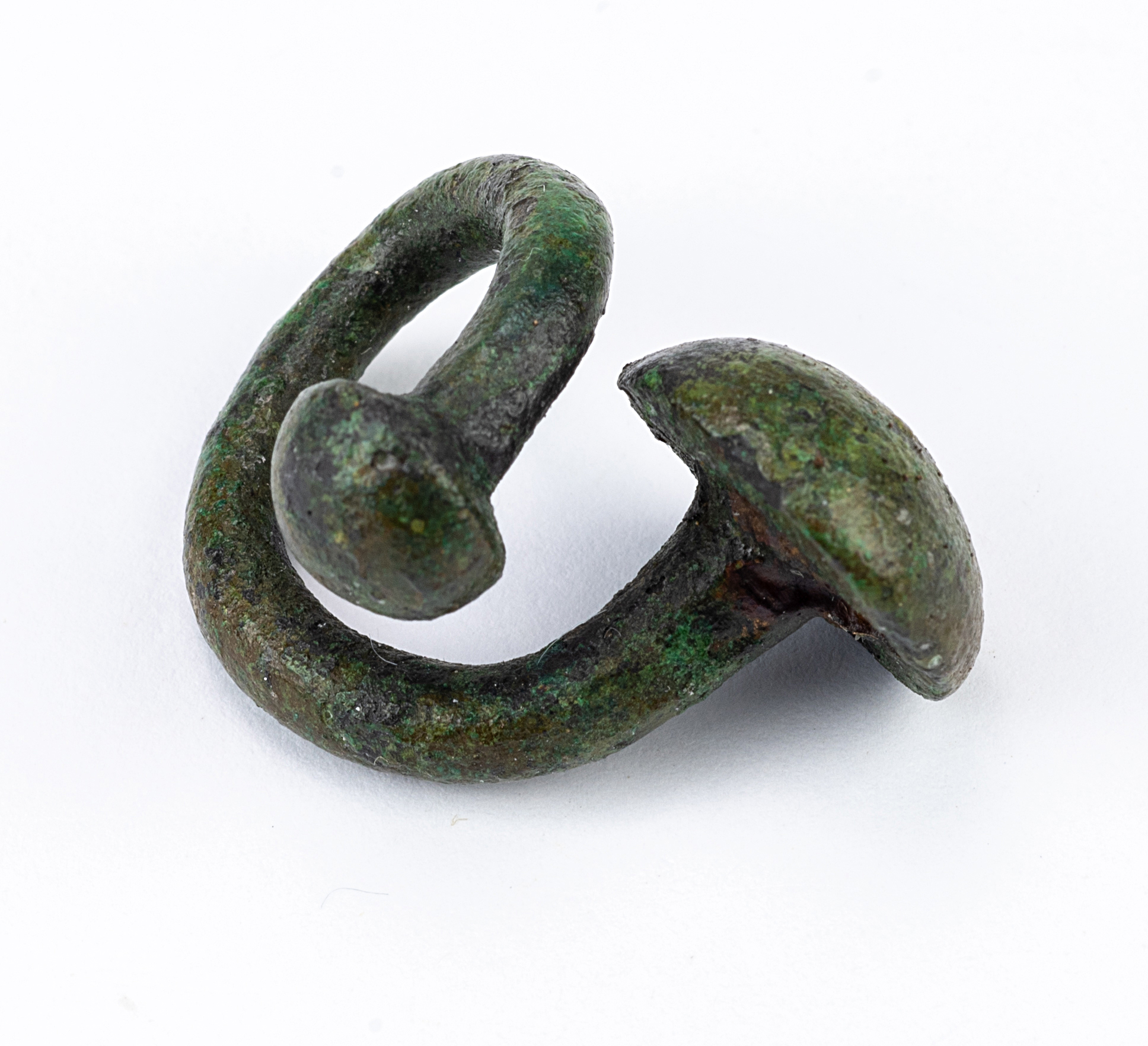
The two nail-shaped earrings on display, discovered in Przędzel or Kopki, Rudnik nad Sanem commune, are classified as double-cone earrings. These ornaments are massive, oval-shaped objects with arched ends and hemispherical heads at both ends. The heads range in diameter from 0.7-1.3 cm and length from 2.5-1.8 cm. The location of the third earring is unknown. This ornament is smaller and lighter than the other two. Its head is shaped like a slightly convex disc and is made of thin sheet metal. The hanging part is made of wire. The disc measures 0.9 cm in diameter. Nail earrings date from the second half of the 7th century BC to the 6th-5th century BC, i.e., the Early Iron Age. Nail earrings, also known as nail earrings or “Scythian” earrings, are artifacts of Eastern origin associated with Scythian culture, primarily its forest-steppe variant. Objects of this type are considered among the most typical elements of women’s attire within the Scythian environment. Their function is not entirely clear. The rather thick ends of some earrings likely prevented them from being hung directly on the ear. The artifacts could have been part of a larger piece of jewelry, forming part of an earring. It is possible that they were worn in the hair above the ear. One hypothesis suggests that this type of jewelry originated in Greece. Through the Black Sea region, they may have reached areas inhabited by the Scythians and then westward, including those inhabited by the Tarnobrzeg Lusatian culture. Another interpretation regarding the origin of nail earrings leads researchers to trace them to Western Siberia. Ornaments of this type spread rapidly not only in areas occupied by the Scythian population, but also in areas with a different cultural tradition. The existence of local workshops producing this type of jewelry cannot be ruled out. The discovery of remains of a foundry, specifically molds for casting earrings, at the settlement in Zawada, Połaniec commune, may indicate such production. The people of the Tarnobrzeg Lusatian culture, modeled on original Scythian ornaments, may have created forms unknown to the Scythians.
Scythian-type Nail-shaped Earrings