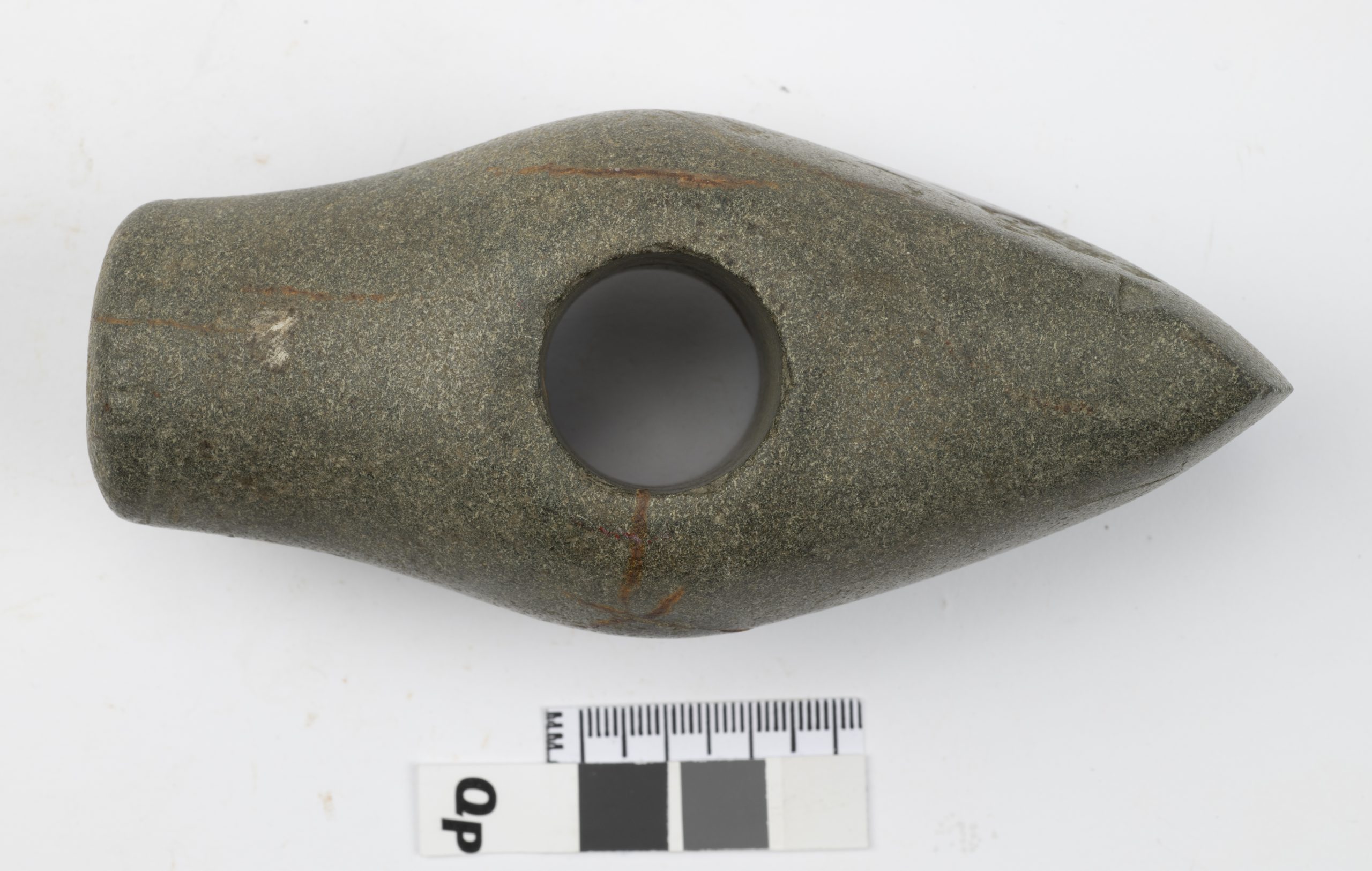
The Harta specimen is a rare example of a decorated stone axe of the Late Neolithic Corded Ware culture, which inhabited large areas of Central Europe, including Poland, between 3200-2400/2300 BCE. It was found accidentally in the village of Harta, Dynów commune, Rzeszów County. In 1957, it was donated to the collections of the National Museum of the Przemyśl Region. The axe is made of serpentinite, a metamorphic rock with a gray-greenish tint. Its structure, particularly its shape in a side view, resembles an upside-down boat, hence the common term for such axe shapes in the scientific literature. Of particular note in the Harta specimen is the decoration on the upper side of the axe and its butt section. The polished, plastic rib running from the butt to the blade finds parallels among the types of axes known as “boat-shaped.” Old Corded Ware axes, characteristic of the oldest, pan-European horizon of the Corded Ware culture. The exhibit differs somewhat in its stocky construction and smaller size from representative forms, but it falls within the category of the oldest Type A axes, first distinguished by Karl W. (Wilhelm) Struve for the Single Grave Culture in the border region of Denmark and Germany. However, the engraved ornament visible in the near-buch section, in the form of slightly diagonal incisions resembling a herringbone motif, refers to decorative motifs used on clay vessels of this culture, primarily on beakers or cups, where it was usually placed in their upper sections, sometimes covering a significant portion of the surface. Stone axes are one of the basic non-ceramic products characteristic of the Corded Ware culture. The number of axes belonging to this community clearly predominates over similar objects in other archaeological cultures, indicating their particular importance in material culture. Stone axes are often found in graves, constituting a major part of the deceased’s equipment, but most are discovered accidentally. The axe in question shows signs of use or secondary damage. These are visible on the upper surface, near the handle hole, and on the butt. The blade, however, aside from minor scratches in the middle section, is undamaged. Considering this and its artistic decoration, it is possible that this axe was not used as a tool, and was more of a prestigious item than a weapon.
Stone axe, Late Neolithic, Corded Ware culture